In electronic, multi-timeframe financial auctions, not all plotted order blocks are engineered equally. A primary failure vector for many developing retail traders is mapping every single counter-candlestick accumulation area on their screens, which converts their analysis into a maze of localized market noise. To achieve an enduring mathematical advantage, a professional structural operator demands ironclad confirmation that institutional capital was genuinely deployed. Within rules-based Smart Money Concepts (SMC), this undeniable digital footprint is documented through Market Imbalances—mechanically classified as a Fair Value Gap (FVG). By deconstructing how single-sided liquidity displacement structures an FVG, you acquire a powerful systemic filter to immediately discard low-expectancy zones and target structural anomalies containing massive unmitigated limit orders.
The Macro Connection: Why Imbalances Fuel Trend Continuation
To understand why a Fair Value Gap serves as the ultimate quality filter, one must evaluate the core mechanics of top-down structural nesting. As systematically charted in our core pillar page, The Ultimate Guide to Multi-Timeframe Supply and Demand Trading for Structural Operators, a true directional edge requires executing trades alongside major commercial entities.
When sovereign central blocks or tier-one liquidity provider algorithms deploy massive capital blocks, they aggressively sweep resting liquidity pools. This aggressive delivery causes localized market orders to match instantly, forcing price to expand violently. The resulting displacement leaves behind an immediate operational void—a sector where only one side of the order book was processed.
Anatomy of a Three-Candle Mechanical Inefficiency
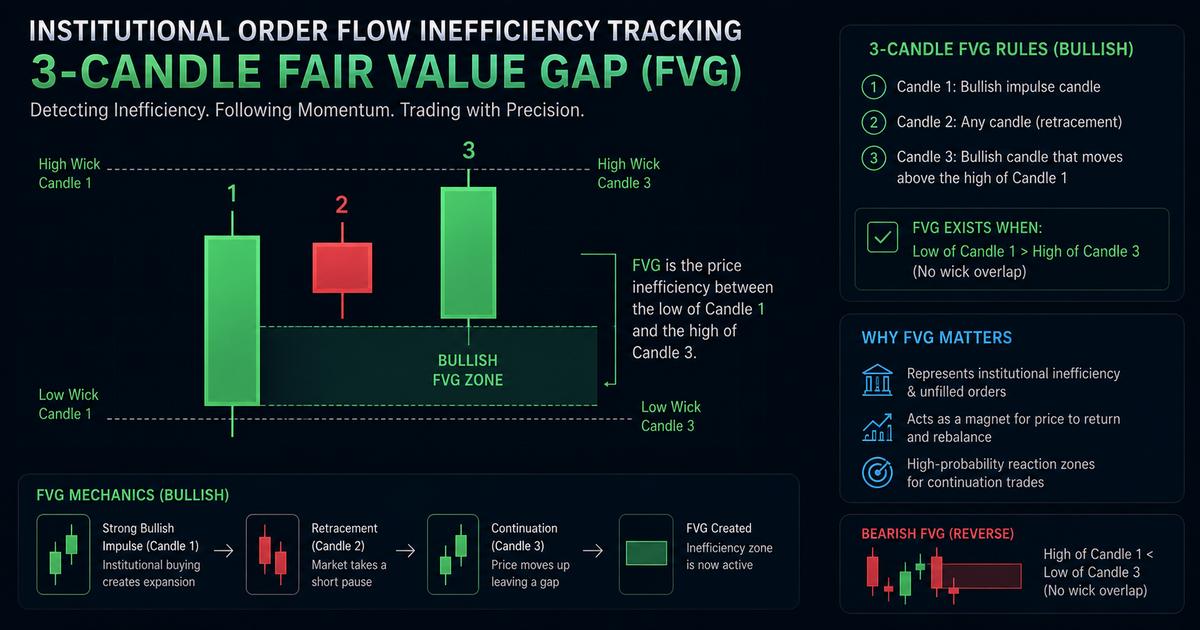
A true professional operator completely eliminates subjectivity from their zone evaluations by enforcing strict mechanical definitions. A valid Fair Value Gap (FVG) is never calculated via an oscillator or lagging indicator; it is identified through the architectural relationship of a specific three-candle sequence:
- Candle 1 (The Anchor): This candle establishes the initial structural floor or ceiling immediately preceding the massive expansion phase.
- Candle 2 (The Displacement): This is the explosive institutional footprint, characterized by an expanding, large candle body that moves rapidly away from the local baseline.
- Candle 3 (The Continuation): This candle documents the subsequent auction sequence immediately following the displacement phase.
The Fair Value Gap is defined as the absolute open distance remaining between the low/high wick of Candle 1 and the high/low wick of Candle 3. If the wicks of Candle 1 and Candle 3 fail to overlap or touch, a verified structural imbalance is confirmed, signaling a high-probability pocket of unmitigated orders.
Filtering High-Probability Zones with Precision Boundaries
Once you have mastered tracking the three-candle imbalance void, you must seamlessly merge this filter with your structural zone setups. Our rules-based trend-following model mandates that a premium or discount zone is only valid if it is directly responsible for generating an immediate FVG expansion.
In our specialized mapping framework detailed in Precision Zone Mapping: Mechanical Boundaries for Demand and Supply Order Blocks, we map a bullish Demand Zone from the opening body of the first candle down to the absolute lowest wick layer of the sequence.
If a mapped demand zone prints a massive upward thrust that fails to leave an open FVG directly above its proximal boundary, that zone is instantly classified as a low-expectancy auction. The lack of an FVG indicates that the transaction order book achieved balance during the breakout, decreasing the likelihood that major institutional resting limit orders remain within your boundaries.
Synergizing Market Structure with Inefficiency Arrays
The true mathematical edge of this architecture comes alive when you combine market inefficiencies with structural continuations. An FVG should never be traded in isolation; its main structural purpose is providing confirmation for underlying institutional arrays.
When an asset prints a valid Break of Structure (BOS) or an aggressive Change of Character (CHoCH) via a definitive candle body closure, we immediately evaluate the breakout leg. If you need a comprehensive review on validating these specific trend continuation shifts, refer to our structural guide on Mastering Market Structure: What are BOS and CHoCH?.
By demanding that a BOS or CHoCH is accompanied by an open FVG, you verify that real institutional displacement fueled the move. When price eventually retraces to heal the imbalance, the underlying order block provides a high-probability, high-asymmetry entry anchor.
Quantitative Risk Profiling and Drawdown Mitigation
Because trading into refined zones with confirmed FVG imbalances shrinks your validation levels to hyper-precise coordinates, position sizing becomes an essential factor for long-term survival. Refined structural arrays provide highly asymmetric Risk-to-Reward profiles, but they also expose operators to localized volatility sweeps as algorithms rebalance market inefficiencies.
To insulate your equity curve from severe drawdowns during these volatile rebalancing events, all execution variables must be managed through precise risk parameters. Utilizing our customized Prop Firm Drawdown Calculator guarantees that position sizes scale down dynamically relative to your absolute stop-loss pip distance. This ensures your capital exposure remains locked within strict risk parameters, protecting your funding metrics even during major liquidity events.
Conclusion: Building a Mechanical Inefficiency Checklist
Filtering your technical charts through clear market imbalance rules completely removes emotional guesswork from your trading routine. By demanding a mechanical three-candle FVG void adjacent to your refined body-to-wick boundaries, you ensure that you only risk capital on high-probability institutional setups. Let market structure drive your directional bias, rely on inefficiencies to filter your entries, and use quantitative calculators to secure your long-term consistency.
Fair Value Gaps & Imbalance FAQ
What is mechanically required to print a valid Fair Value Gap (FVG)?
A valid Fair Value Gap requires a sequence of three consecutive candlesticks. An FVG is printed when the wick of Candle 1 and the wick of Candle 3 fail to overlap, leaving an open pool of single-sided institutional displacement within Candle 2.
Why are supply and demand zones without an adjacent FVG considered low probability?
Zones lacking a clear immediate FVG signify localized, balanced auction mechanics instead of massive institutional interest. Without an unmitigated market inefficiency left behind, there is no structural guarantee that significant resting limit orders remain within the zone.
How does an operator incorporate FVGs into a trend-following structural matrix?
In a trend-following regime, operators use the FVG as a premium/discount quality filter. We look for major structural continuations (BOS) accompanied by immediate inefficiencies. We then align entries at the underlying order block boundary when price returns to heal the imbalance.