In the arena of professional institutional trading, relying on standard lagging indicators or superficial geometric trendlines is a guaranteed vector for capital degradation. To track the footprint of institutional order books with precision, a structural operator must master the mechanics of Market Structure. Market structure maps the raw psychology of major market participants by tracking how price prints sequential structural legs. At the heart of rules-based Smart Money Concepts (SMC) lie two critical structural phenomena: Break of Structure (BOS) and Change of Character (CHoCH). Understanding how to differentiate and mechanically validate these two mechanics is what separates baseline retail traders from consistently profitable, systematic structural operators.
The Foundation of Structural Tracking: Is the Trend Valid?
Before diving into execution nuances, we must establish a core principle: markets move via cycles of accumulation, manipulation, and distribution. In a standard trend-following environment, price does not move linearly; it creates impulse waves and corrective retracements.
For structural operators, tracking these phases accurately requires mechanical alignment with macro capital flow. As detailed in our comprehensive pillar guide, The Ultimate Guide to Multi-Timeframe Supply and Demand Trading for Structural Operators, trading edges are born when you align your lower-timeframe confirmations directly with structural Demand Zones established on the macro horizons.
Demystifying the Break of Structure (BOS)
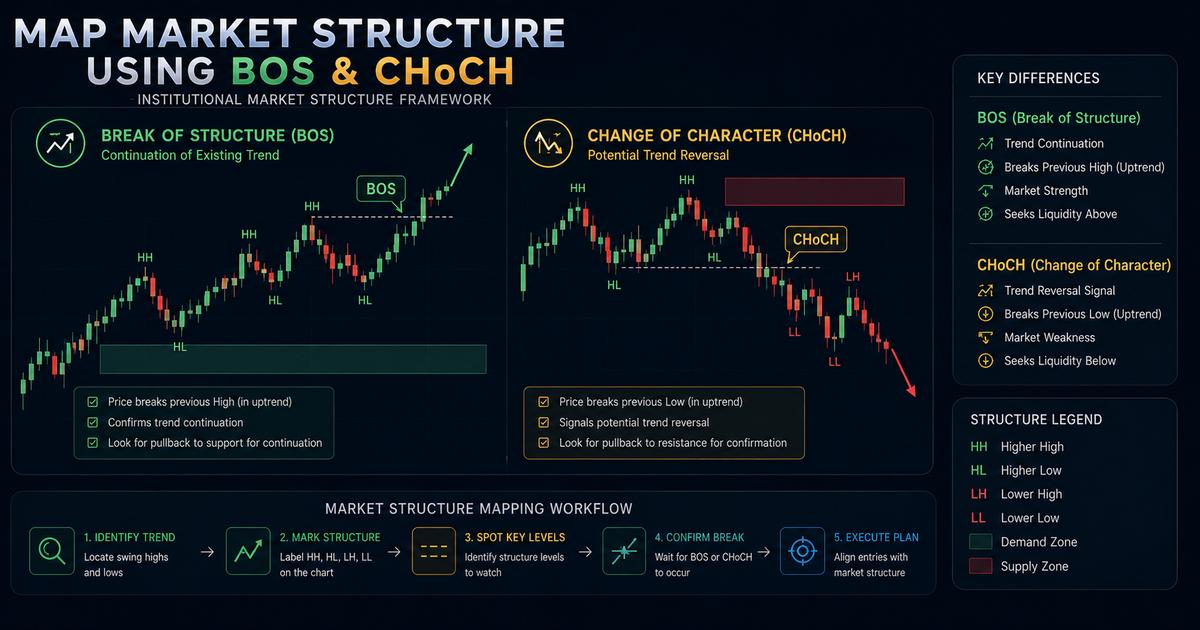
A Break of Structure (BOS) is the fundamental mechanical signature of a trend's continuation. When a market is locked in an established directional flow, institutional capital reinforces that direction by continuously clearing out opposing counterparty liquidity.
- Bullish BOS: Occurs when price systematically advances upward, breaking and successfully closing past the previous structural Swing High, forming a new Higher High (HH).
- Bearish BOS: Occurs when price drives downward, expanding past the established structural Swing Low and printing a definitive close to establish a new Lower Low (LL).
The critical distinction that rules-based operators enforce is the Candle Body Closure. A valid BOS cannot be printed by a mere wick expansion. Wicks breaching a structure indicate localized liquidity sweeps—engineered traps designed by market makers to absorb retail breakout stops before driving price rapidly in the opposite direction.
Understanding the Change of Character (CHoCH)
While a BOS signifies momentum and trend extension, a Change of Character (CHoCH) denotes the exact point of structural transition or potential trend reversal. It is the very first structural indication that the dominant market order flow is shifting hands between buyers and sellers.
Imagine a bullish trend-following sequence printing consecutive Higher Highs and Higher Lows via multiple valid BOS steps. Eventually, price mitigates a major higher-timeframe Supply Array and loses upward velocity. When price reverses and aggressively breaks below the *last valid Higher Low* that was responsible for creating the recent peak, a CHoCH is triggered.
A CHoCH confirms that institutional order flow is no longer supporting the previous trend's structural integrity. It provides the initial warning that a deeper macro shift or structural inversion is actively underway.
Synergizing Trend-Following Logic with Validated Demand Zones
The true mathematical edge of this architecture comes alive when you combine market structure transitions with institutional Demand Zones under a trend-following framework. Instead of executing trades randomly mid-range, structural operators utilize a top-down nesting methodology:
- Identify Macro Bias: Map the H4 or Daily structure to ensure you are looking for long vectors in an overall pro-trend environment.
- Locate Unmitigated Demand: Draw the precise footprint of the institutional candlestick where aggressive displacement and Fair Value Gaps (FVGs) originated.
- Wait for the Mitigation: Exercise extreme patience as price retraces into the premium/discount boundaries of your identified demand zone.
- Lower-Timeframe CHoCH Confirmation: Drop to the M5 or M1 execution engine. Once price taps the macro zone, look for a micro CHoCH to confirm institutional accumulation. Trigger your long entry at the nested micro order block.
By demanding a lower-timeframe CHoCH inside a higher-timeframe demand zone, you insulate your portfolio against premature executions, ensuring you are entering exactly when the trend alignment syncs across multiple timeframes.
Position Sizing and Capital Risk Allocation Matrix
Nesting entries within micro-level structures allows you to capture highly asymmetric Risk-to-Reward parameters, sometimes unlocking 1:5 or 1:10+ distributions. However, executing entries based on tight micro validation levels requires rigorous mathematical position sizing.
Because structural stop-losses placed tucked beneath an M1/M5 demand zone might only span 3 to 6 pips, executing arbitrary retail lot sizes can result in severe equity drawdowns. For operators executing trades across volatile assets, utilizing automated calculators is mandatory to keep capital exposure strictly fixed relative to your absolute account balance.
Whether managing proprietary funding accounts or private balances, utilizing our structural risk engines—such as our specialized Prop Firm Drawdown Calculator—guarantees that consecutive minor stop-outs from counter-trend liquidity sweeps never violate your daily protective drawdown parameters.
Conclusion: Building a Mechanical Execution Checklist
Mastering market structure mapping eliminates emotional guessing from your technical routines. By requiring a definitive candle body closure for a BOS and keeping execution signals anchored to high-probability lower-timeframe CHoCH shifts inside macro demand structures, you realign your trading parameters with systematic market flow. Protect your trading capital, maintain fixed mathematical exposures, and let structural mechanics compound your consistency.
Market Structure & Order Flow FAQ
What is the key difference between BOS and CHoCH?
A Break of Structure (BOS) confirms the continuation of an existing market trend by closing past a structural swing high or low. A Change of Character (CHoCH) signals the initial structural shift or reversal of the current trend, indicating that order flow is shifting dominance to the opposing side.
Does a structural break require a body close or a wick sweep?
For structural validity as a BOS or CHoCH, the candle must achieve a definitive body closure beyond the structural level. A mere wick breach is classified as a liquidity sweep, which often precedes a sharp reversal rather than a trend continuation.
How do you combine CHoCH with Demand Zones in a Trend-Following strategy?
In a bullish trend-following setup, operators wait for the asset to mitigate a validated higher-timeframe demand zone. Once the lower-timeframe hits the zone, we look for a micro-level CHoCH to confirm institutional accumulation. This provides an asymmetric entry point aligned with the macro trend.