One of the most dangerous structural errors a retail trader can commit is treating a "Lot" as a universal unit of financial risk. Executing a fixed volume of 1.00 lot on GBPUSD, Spot Gold (XAUUSD), or Crude Oil (WTI) does not represent a uniform market exposure. Instead, it exposes your portfolio to wildly asymmetrical liability profiles. To build an institutional-grade risk strategy, an operator must look past the entry buttons on a commercial terminal and fully deconstruct the hidden variables of Contract Sizes, Decimal Metrics, and Pip Values.
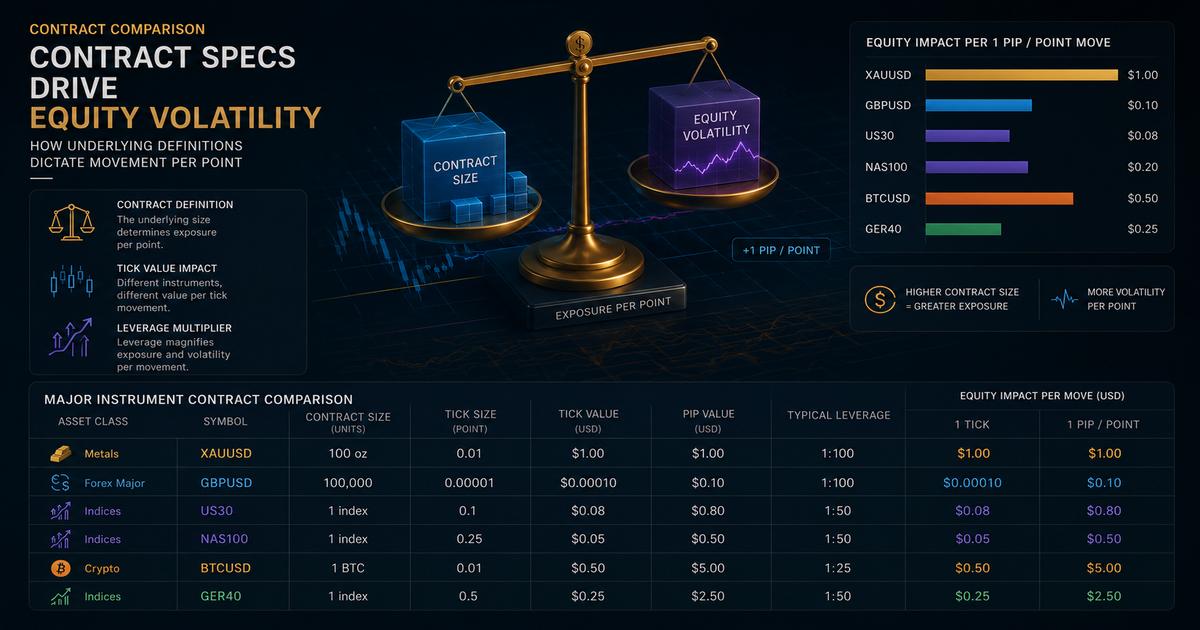
The Anatomy of a Standard Lot: Underlying Asset Scales
The fundamental reason why a standard lot carries different risks across asset classes lies within the broker's underlying definition of a single contract unit. When you click "Buy 1.00 Lot," you are acquiring a massive leverage bloc defined by institutional liquidity networks:
- Forex Majors (e.g., GBPUSD): 1 Standard Lot equals exactly 100,000 units of the base currency (GBP).
- Spot Gold (XAUUSD): 1 Standard Lot equals exactly 100 Troy Ounces of physical gold.
- Crude Oil (WTI/Brent): 1 Standard Lot typically equals exactly 1,000 Barrels of oil.
Because the underlying metrics are completely detached from one another—comparing British Pounds to physical ounces of gold and barrels of oil—the pricing fluctuations scale on radically different mathematical axes. This structural difference is why mastering position sizing math is critical to survival. To see how these variables fit into a complete portfolio optimization equation, read our comprehensive guide on The Mathematics of Position Sizing: Managing Risk in High-Volatility FX and Gold Markets.
The Pip Value Mathematical Breakdown
To explicitly map the true financial impact of an asset's move, we have to look at how a single price increment (a pip or a point) interacts with the asset's contract size on a USD-denominated trading account:
1. Forex Major Framework (GBPUSD)
Currencies are calculated using 4-decimal precision (0.0001 configuration).
Pip Formula = 0.0001 (1 Pip) × 100,000 (Contract Size)
Pip Value = $10.00 per Standard Lot
2. Spot Gold Framework (XAUUSD)
Gold pricing models scale on a 2-decimal configuration. Brokers define a standard price increment (or standard point) as a $0.01 shift in the metal price.
Point Formula = $0.01 (1 Point) × 100 (Contract Size)
Point Value = $1.00 per Standard Lot (or $100.00 per complete $1.00 delta)
3. Crude Oil Framework (WTI)
Oil functions under a 2-decimal matrix where a $0.01 price move represents the base standard point increment.
Point Formula = $0.01 (1 Point) × 1,000 (Contract Size)
Point Value = $10.00 per Standard Lot (or $1,000.00 per complete $1.00 delta)
| Asset Class | Standard Lot Unit Size | Base Move Increment | Financial Impact (Per 1.00 Lot) |
|---|---|---|---|
| GBPUSD | 100,000 Pounds | 1 Pip (0.0001) | $10.00 USD |
| Gold (XAUUSD) | 100 Troy Ounces | 1 Dollar Move ($1.00) | $100.00 USD |
| Crude Oil (WTI) | 1,000 Barrels | 1 Dollar Move ($1.00) | $1,000.00 USD |
The Hidden Trap: Average True Range (ATR) Variance
Looking strictly at pip calculations creates a deceptive illusion. An uneducated operator might look at the metrics above and deduce that because 1 lot of GBPUSD yields $10.00 per pip, and 1 lot of Gold yields $1.00 per point ($0.01 move), that Gold is a safer instrument. This assumption is a catastrophic mathematical fallacy.
The missing component in this equation is the Average True Range (ATR), which measures real-world price volatility. Over a standard 24-hour cycle, GBPUSD might move roughly 80 to 120 pips ($800 - $1,200 variation per standard lot). Meanwhile, Gold can easily expand across a dynamic $30.00 to $50.00 delta range, which triggers a staggering $3,000 to $5,000 swing in account equity per standard lot. Gold's microstructure allows it to cross large distance ranges in seconds, destroying fixed-lot configurations instantly.
Evaluate Pip Variance Instantly
Input your proposed risk profile below to calculate how point variations impact capitalization before committing orders via a live terminal link.
Forex Position Size Calculator
Amount at Risk: $0.00
Strategic Risk Equalization Protocol
To prevent market variance from liquidating your portfolio or breaching strict prop firm limits, you must execute an institutional risk-unit approach. Never think in terms of volume; instead, think in terms of Capital at Risk.
By establishing a dynamic framework where your lot size scales down as asset volatility and stop-loss distances scale up, you force the final dollar liability to remain completely identical across every instrument. A loss on a GBPUSD breakout strategy will cost your account exactly the same 1% risk unit as an aggressive intraday pull-back setup inside the spot Gold market.
Conclusion: Standardizing Risk Across the Board
The market does not care where you click entry; it only calculates the raw mathematical data of your contract exposure. Understanding the underlying machinery of pip valuation transitions your strategy away from reckless retail speculation and moves it into the domain of institutional variance control. By neutralizing asset-class asymmetry through exact mathematical position filters, you ensure your platform stays resilient and ready to harness long-term compounding growth models.
Pip Value & Contract Specifications FAQ
Why does 1 standard lot on Gold risk more money than on GBPUSD per pip?
Gold (XAUUSD) has a standard contract size of 100 troy ounces, meaning a $0.01 price move (1 pip/point) equals $1.00 per lot. Currency pairs like GBPUSD operate on 100,000 units, where a 1-pip move (0.0001) equals $10.00. However, Gold's extreme daily price fluctuations (ATR) make its real-world variance significantly wider than FX.
What is the standard contract size for Crude Oil (WTI)?
In standard retail brokerages, 1.00 standard lot of Crude Oil represents exactly 1,000 barrels. Consequently, a $0.01 change in the oil price translates to a $10.00 fluctuation in account balance per standard lot.
How does the quote currency affect pip value calculations?
If the quote currency (the second currency in a pair) matches your account base currency (e.g., trading EURUSD on a USD account), the pip value is static. If it differs, the position sizing engine must apply a dynamic conversion rate to determine the exact risk in your account currency.