The ultimate battlefield in modern financial speculation is not mapped out on chart indicators or macroeconomic calendars. It exists entirely within the internal cognitive wiring of your own brain.
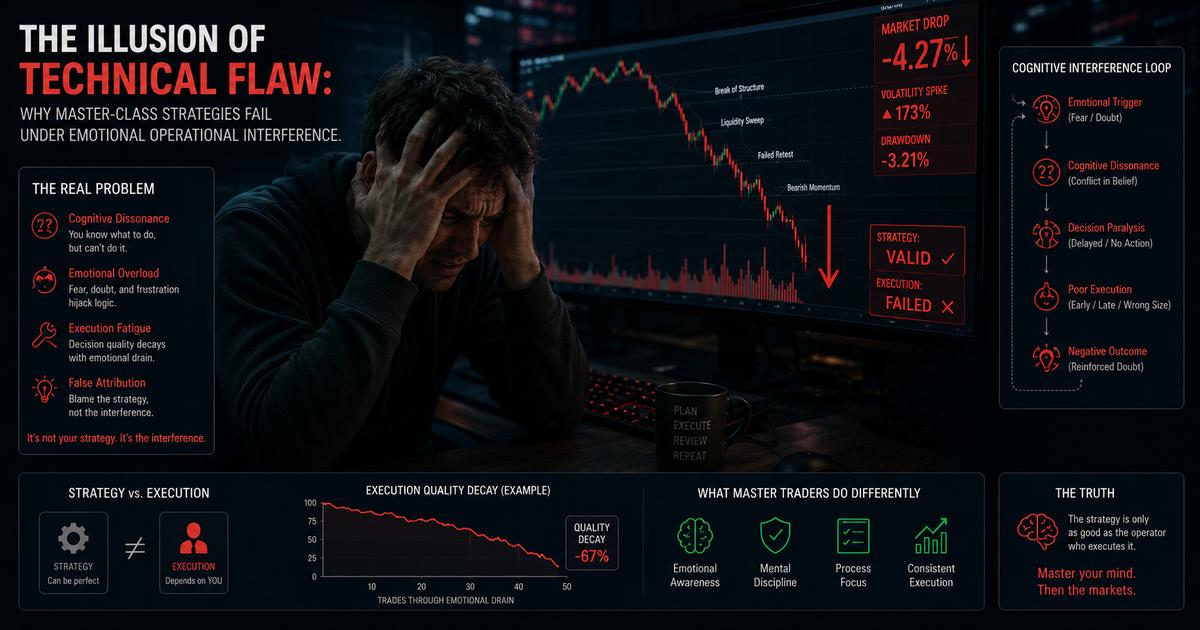
The Secret Diagnosis: Why Profitable Strategies Bleed Capital
Retail participants spend years searching for the perfect technical entry mechanism. They jump across technical charting concepts, testing exponential moving averages, complex Fibonacci ratios, or institutional Supply and Demand zones. Yet, when handed a mathematically verified system with a historically robust expectancy profile, the vast majority of independent operators will still manage to lose money.
The strategy itself is rarely the root cause of systemic portfolio liquidation. The system fails because the human operating system driving the software is plagued by primitive biological programming. Your brain evolved over millions of years to prioritize immediate physical survival, seek comfort, and avoid pain at all physical costs.
When you transplant that survival-driven evolutionary architecture into a dynamic, probabilistic arena like live foreign exchange or commodity markets, your biological instincts betray you. The psychological impulses that keep you safe in the real world—such as fleeing from uncertainty or fighting back when attacked—manifest as fatal execution errors on your trading terminal.
🛡️ The Mathematical Invalidation Point: Psychological panic occurs exclusively when your allocation parameters are unquantified. Eliminate execution fear at the source by utilizing our comprehensive guide on Position Sizing 101: The Math Behind Long-Term Trading Success.
The Four Horsemen of Trading Self-Sabotage
To permanently alter your capital performance curve, you must learn to identify the exact moments your execution behavior shifts from objective rule adherence to emotional survival-driven responses.
1. Recency Bias and the Illusion of System Failure
Recency Bias is the mental error of overweighting recent occurrences while completely disregarding long-term baseline data. Imagine executing an institutional multi-timeframe trend system that possesses a verified 60% win rate. Mathematically, it is entirely normal to experience four consecutive losses within a sample distribution of 100 executions.
However, Recency Bias forces your mind to zoom in exclusively on those four immediate losses. Your brain interprets this localized run of bad luck as total system failure. In a state of artificial panic, the trader abandons the strategy, changes indicator parameters mid-week, or begins skipping subsequent valid signals—only to watch from the sidelines as the system inevitably executes a massive winning streak that would have wiped out the earlier drawdown.
2. FOMO: The Aggressive Chase Into Institutional Liquidity Pools
Fear of Missing Out (FOMO) is a direct manifestation of basic human greed. When a major currency cross like GBPUSD or a volatile commodity like Gold prints a massive, high-momentum breakout candle without offering a technical retest, the untrained operator experiences extreme internal discomfort.
Terrified of missing a massive trend expansion, the trader violates their entry criteria and clicks buy right at the very top of the extension. Institutional algorithms look for this exact retail clustering behavior. They utilize that frantic buy order volume to match their massive institutional sell execution orders. The market reverses instantly, trapping the retail trader at the absolute high of the day.
3. Revenge Trading: The Financial Death Spiral
Revenge Trading is an ego-driven refusal to accept a market loss. When a stop-loss is triggered, the primitive ego perceives it as a personal attack on your intelligence. Instead of calmly accepting the loss as a normal operational expense of a statistical model, the trader immediately enters a secondary, larger position in the opposite direction without any technical confirmation.
This is pure emotional gambling. The trader is trying to "win back" their capital from the market. Within hours, a minor, easily manageable 1% portfolio loss escalates into a catastrophic multi-tier liquidation spiral that threatens the core survival of the entire account equity.
⚡ Systematic Rule Reinforcement: Eradicating emotional guesswork requires a rigid execution script that leaves zero choices to the conscious mind. Master our objective top-down framework in Multi-Timeframe Analysis: How to Identify High-Probability Trends.
The Tactical Cure: Building an Unshakable Trading Mindset
Overcoming these destructive biological impulses cannot be achieved by pure willpower or wishful thinking. You must implement concrete, structural operational frameworks that protect your capital from your own mind.
The Power of Detachment: Thinking in Probabilities
Professional institutional operators view individual executions with total emotional indifference. They understand that a single trade is completely meaningless. It represents just one individual observation point out of a long sequence of thousands of historical iterations.
When you accept that any individual trade has a random outcome, your performance anxiety drops to zero. You do not care if the immediate position hits its stop-loss or take-profit boundary, because you possess empirical proof that your overarching framework yields positive mathematical expectancy over the long haul.
🛠️ Infrastructure Optimization: The most practical way to eliminate psychological human error is to remove human decisions from the equation completely. Discover our selected tech stack in The Best Trading Tools for 2026: A Comprehensive Guide for Retail Traders.
Deploying Mechanical Platform Circuit Breakers
If you struggle with emotional impulse control during volatile trading sessions, you must deploy mechanical constraints. Do not rely on your own discipline when your brain is flooded with dopamine or cortisol.
- Rigid Max Daily Loss Parameters: Program your institutional brokerage platform or specialized trading terminal to freeze your account access immediately upon striking a set daily drawdown threshold (e.g., 2% of total capital).
- The Two-Loss Extinguisher Rule: Establish a binding personal operating standard: If your terminal registers two consecutive technical stop-loss executions during a single trading session, you shut down your machine, step away from your desk, and refuse to open the platform until the next calendar day.
- Comprehensive Trading Logs: Force yourself to document the psychological state of every transaction. Before clicking execute, write down an explicit sentence: "Am I executing this trade based entirely on verified structural setups, or am I reacting to localized chart movement?"
Conclusion: Transitioning From Competitor to Business Entity
Trading mastery is not an intellectual challenge of discovering secret indicators. It is an exercise in self-mastery. The markets operate as an unfeeling mirror, ruthlessly exposing every single internal insecurity, character flaw, and emotional vulnerability you possess.
Stop treating your trading portal like a financial lottery system. Build robust mechanical parameters, honor your statistical data models, step away from individual trade outcomes, and treat your independent capital operation like a serious, data-driven institutional enterprise.
Trading Psychology FAQ
Why do traders abandon verified strategies during a losing streak?
Traders abandon verified frameworks due to cognitive Recency Bias. The human brain naturally overweights recent negative outcomes over long-term historical statistics, causing artificial panic and unforced system changes.
How can I stop revenge trading after a major financial loss?
To stop revenge trading, you must implement mechanical operational circuit breakers. This includes setting rigid electronic platform limits, turning off your workstation after hitting your maximum daily loss threshold, and separating your identity from individual trade outcomes.
Does trading automation or utilizing EAs eliminate psychological risk completely?
Automation shifts psychological risk rather than eliminating it. While an EA removes real-time manual execution hesitation, the operator still faces the psychological burden of choosing when to turn the system off or leave it running during an inevitable backtested drawdown phase.