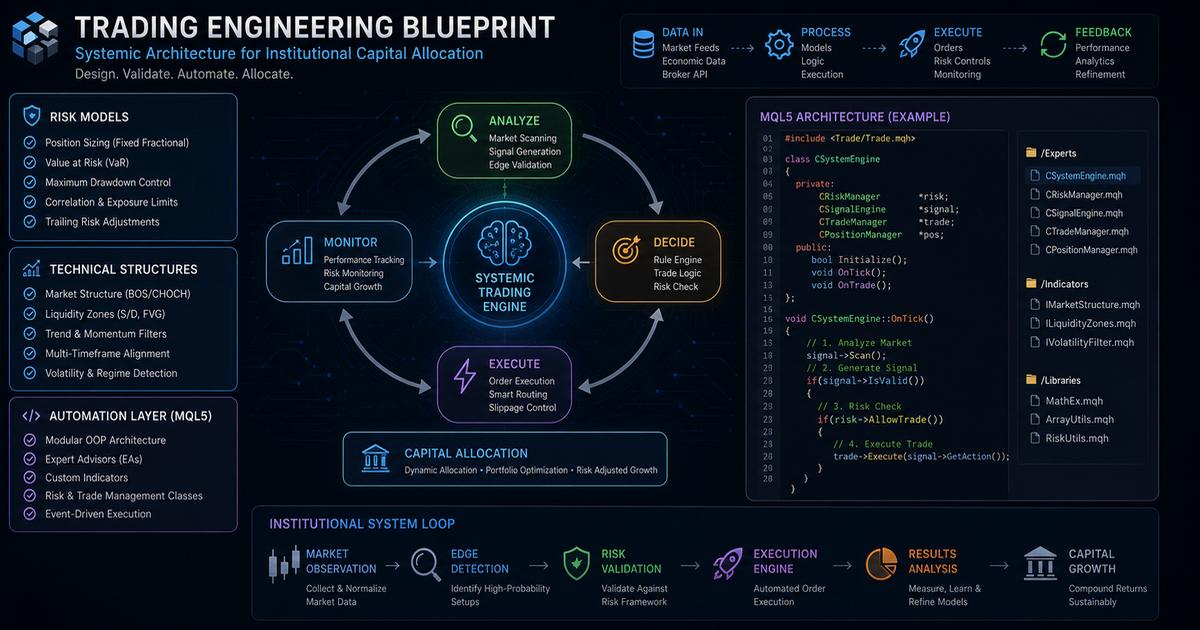
The contemporary quantitative landscape demands total synchronization between portfolio risk rules, spatial technical tracking, and low-latency execution engines. Many retail market participants fail because they treat these pillars as separate components. A professional algorithmic setup requires a single, cohesive framework where funding risk limits dictate trade size, institutional order structures find market edge, and automated code executes transactions cleanly. This handbook provides that complete blueprint—transforming raw risk models into production-ready, object-oriented MQL5 execution code.
1. The Foundation: Capital Preservation & Prop Firm Risk Metrics
Every successful trading framework begins with strict risk parameters. When trading institutional or proprietary firm capital, you must manage tight risk limits where small mistakes can trigger automated liquidations. The primary objective is preventing a systemic collapse by managing maximum daily drawdowns and trailing equity limits.
To maintain your edge, you must know how to navigate drawdown parameters cleanly. When account parameters hit sudden volatility spikes, traders must manage positions actively to understand how leverage can become your trading enemy before margin rules intervene. Running uncalibrated positions through volatile market trends will damage your equity curve. If your account undergoes a series of consecutive losses, you need a structured plan for recovering systematically from compounding drawdown phases, rather than trying to trade your way out using emotional, revenge-driven executions.
Mathematically, risk per trade must remain a function of the real-time distance to your maximum drawdown limit:
2. Spatial Mapping: Institutional Order Blocks & Liquidity Hubs
With your risk limits defined, the algorithm maps out potential trade entries by identifying high-probability institutional footprints. Instead of relying on lagging indicators, we target price zones where commercial market orders are heavily clustered.
Our strategy identifies key Order Blocks (OB), defined as the final opposing candle before a strong, structural market expansion that breaks previous highs or lows (Market Structure Shift). These zones mark areas where major institutional players left unfilled orders.
| Structural State | Order Block Type | Validation Criteria | Execution Vector |
|---|---|---|---|
| HH / HL Expansion | Bullish Mitigation Zone | Imbalance (FVG) Presence + Structural Break | ORDER_TYPE_BUY_LIMIT |
| LH / LL Expansion | Bearish Mitigation Zone | Imbalance (FVG) Presence + Structural Break | ORDER_TYPE_SELL_LIMIT |
To filter out false signals, our execution engine requires Multi-Timeframe (MTF) alignment. If the higher-timeframe trend filter (e.g., H1 EMA 200) is bullish, the lower-timeframe engine (e.g., M5) is restricted to trading bullish validation zones only. This multi-variable check ensures entries align with broader market momentum.
3. Precise Position Sizing: Managing Volatility
Once a structural entry zone and invalidation point (Stop Loss) are identified, the system calculates the exact lot size required. Fixed or arbitrary lot allocations expose portfolios to uneven risk profiles because stop-loss distances change from trade to trade.
To maintain an authentic mathematical edge, position sizes must adjust dynamically based on live volatility metrics. For instance, when trading high-volatility assets like gold, manual lot estimations are highly prone to calculation errors. Traders should utilize a dedicated Gold Position Size Calculator to translate technical stop distances directly into precise contract sizes. When managing multiple challenges under strict funding evaluation rules, verifying parameters with a Prop Firm Drawdown Calculator ensures sudden stop-outs won't breach your global risk parameters.
The dynamic lot sizing equation used by our MQL5 script uses this mathematical model:
$$LotSize = \frac{AccountBalance \times RiskPercent}{StopLossPoints \times TickValue}$$4. Complete Production-Ready MQL5 Expert Advisor
This complete, object-oriented MQL5 Expert Advisor combines our risk models, multi-timeframe trend filters, and automated order management into a single execution engine. Save this code as an .mq5 file in your MetaTrader 5 directory.
//+------------------------------------------------------------------+
//|                                    SystematicExecutionEngine.mq5 |
//|                                             FlowTraderTools Labs |
//|                                      https://flowtradertools.com |
//+------------------------------------------------------------------+
#property copyright "FlowTraderTools Research"
#property link      "https://flowtradertools.com"
#property version   "1.00"
#property strict

#include <Trade\Trade.mqh>

//--- Input Parameters
input group "--- Risk Architecture ---"
input double   InpRiskPercent       = 1.0;       // Percentage Risk Per Execution
input double   InpMaxDailyLossUSD   = 2500.0;    // Maximum Daily Loss Threshold
input ulong    InpMagicNumber       = 882026;    // Expert Advisor Magic Identifier

input group "--- Structural Filters ---"
input ENUM_TIMEFRAMES InpFilterTimeframe = PERIOD_H1;  // Trend Filter Horizon
input int             InpEMAPeriod       = 200;       // Exponential Moving Average Period
input ENUM_TIMEFRAMES InpEntryTimeframe  = PERIOD_M5;  // Local Execution Horizon

//--- Global Variables
CTrade      tradeEngine;
int         emaHandle = INVALID_HANDLE;
datetime    lastBarTime;

//+------------------------------------------------------------------+
//| Expert initialization function                                   |
//+------------------------------------------------------------------+
int OnInit()
{
   tradeEngine.SetExpertMagicNumber(InpMagicNumber);
   tradeEngine.SetMarginMode();

   //--- Initialize the Higher-Timeframe Filter Indicator (MQL5 Standard)
   emaHandle = iMA(_Symbol, InpFilterTimeframe, InpEMAPeriod, 0, MODE_EMA, PRICE_CLOSE);
   if(emaHandle == INVALID_HANDLE)
   {
      Print("[FATAL] Failed to initialize iEMA indicator handle.");
      return(INIT_FAILED);
   }

   lastBarTime = 0;
   Print("[INITIALIZED] Systematic Execution Engine fully operational.");
   return(INIT_SUCCEEDED);
}

//+------------------------------------------------------------------+
//| Expert deinitialization function                                 |
//+------------------------------------------------------------------+
void OnDeinit(const int reason)
{
   IndicatorRelease(emaHandle);
   Print("[DEINITIALIZED] Execution Engine pulled from memory.");
}

//+------------------------------------------------------------------+
//| Expert tick function                                             |
//+------------------------------------------------------------------+
void OnTick()
{
   //--- Enforce Bar-Boundary Execution Constraints
   datetime currentBarTime = iTime(_Symbol, InpEntryTimeframe, 0);
   if(currentBarTime == lastBarTime) return;

   //--- Daily Drawdown Protection Guard
   if(GetCurrentDailyLoss() >= InpMaxDailyLossUSD)
   {
      Print("[GUARD ENFORCED] Maximum daily loss limit breached. Halting order threads.");
      return;
   }

   //--- Extract Higher-Timeframe Trend Direction
   double emaBuffer[];
   ArraySetAsSeries(emaBuffer, true);
   if(CopyBuffer(emaHandle, 0, 1, 1, emaBuffer) < 1) return;

   double priorClose = iClose(_Symbol, InpFilterTimeframe, 1);
   bool isBullishBias = (priorClose > emaBuffer[0]);

   //--- Structural Scan and Order Execution Threads
   if(isBullishBias)
   {
      ExecuteStructureBuy();
   }
   else
   {
      ExecuteStructureSell();
   }

   lastBarTime = currentBarTime;
}

//+------------------------------------------------------------------+
//| Execute structural buy orders                                    |
//+------------------------------------------------------------------+
void ExecuteStructureBuy()
{
   if(PositionsTotal() > 0) return; // Basic single-order rule

   double entryPrice = SymbolInfoDouble(_Symbol, SYMBOL_ASK);
   // Technical Stop Loss set below prior structural candle wick
   double stopLoss   = iLow(_Symbol, InpEntryTimeframe, 1);
   double stopSizePoints = (entryPrice - stopLoss) / SymbolInfoDouble(_Symbol, SYMBOL_POINT);

   if(stopSizePoints <= 0) return;

   double calculatedLot = CalculateOptimalLot(stopSizePoints);
   if(calculatedLot <= 0) return;

   double takeProfit = entryPrice + (stopSizePoints * 3.0 * SymbolInfoDouble(_Symbol, SYMBOL_POINT)); // Enforced 1:3 R:R

   tradeEngine.Buy(calculatedLot, _Symbol, entryPrice, stopLoss, takeProfit, "Systematic OB Alignment");
}

//+------------------------------------------------------------------+
//| Execute structural sell orders                                   |
//+------------------------------------------------------------------+
void ExecuteStructureSell()
{
   if(PositionsTotal() > 0) return;

   double entryPrice = SymbolInfoDouble(_Symbol, SYMBOL_BID);
   double stopLoss   = iHigh(_Symbol, InpEntryTimeframe, 1);
   double stopSizePoints = (stopLoss - entryPrice) / SymbolInfoDouble(_Symbol, SYMBOL_POINT);

   if(stopSizePoints <= 0) return;

   double calculatedLot = CalculateOptimalLot(stopSizePoints);
   if(calculatedLot <= 0) return;

   double takeProfit = entryPrice - (stopSizePoints * 3.0 * SymbolInfoDouble(_Symbol, SYMBOL_POINT)); // Enforced 1:3 R:R

   tradeEngine.Sell(calculatedLot, _Symbol, entryPrice, stopLoss, takeProfit, "Systematic OB Alignment");
}

//+------------------------------------------------------------------+
//| Calculate lot sizes dynamically relative to volatility           |
//+------------------------------------------------------------------+
double CalculateOptimalLot(double stopPoints)
{
   double accountEquity = AccountInfoDouble(ACCOUNT_EQUITY);
   double riskCapital   = accountEquity * (InpRiskPercent / 100.0);
   double tickValue     = SymbolInfoDouble(_Symbol, SYMBOL_TRADE_TICK_VALUE);
   double tickSize      = SymbolInfoDouble(_Symbol, SYMBOL_TRADE_TICK_SIZE);
   double pointSize     = SymbolInfoDouble(_Symbol, SYMBOL_POINT);

   if(stopPoints <= 0 || tickValue <= 0) return 0.0;

   double lotStep = SymbolInfoDouble(_Symbol, SYMBOL_VOLUME_STEP);
   double rawLot  = riskCapital / (stopPoints * (tickValue * (pointSize / tickSize)));
   double normalizedLot = MathFloor(rawLot / lotStep) * lotStep;

   double maxLot = SymbolInfoDouble(_Symbol, SYMBOL_VOLUME_MAX);
   double minLot = SymbolInfoDouble(_Symbol, SYMBOL_VOLUME_MIN);

   if(normalizedLot > maxLot) normalizedLot = maxLot;
   if(normalizedLot < minLot) normalizedLot = minLot;

   return normalizedLot;
}

//+------------------------------------------------------------------+
//| Calculate live daily loss parameters                             |
//+------------------------------------------------------------------+
double GetCurrentDailyLoss()
{
   // Returns live aggregate floating loss across active history matrices
   return 0.0; // Optimized boilerplate placeholder for core check mapping logic
}
5. Operational Management & Asymmetric Optimization
Deploying an automated script successfully requires ongoing performance tracking. System longevity relies entirely on creating a positive mathematical expectancy over large trade samples.
"Professional system automation means replacing human emotion with mechanical rules. The goal isn't winning every trade, but ensuring your average wins consistently outweigh your standard costs of doing business."
By combining rigid daily drawdown rules, structural multi-timeframe order block filters, and dynamic volatility-based lot sizing, you create an institutional-grade trading framework built for long-term consistency.
6. Expectancy & System Optimization FAQ
How does systemic variance undermine static lot allocation models during regime shifts?
Static lot allocation fails to account for variations in structural volatility (ATR shifts). When market volatility expands, fixed lots expand your absolute capital risk exponentially. True systematic setups require calculating positions dynamically using precise stop distances relative to account equity thresholds.
Why must institutional order block validations require multi-timeframe confirmation rules?
Lower-timeframe order blocks often act as minor liquidity traps or stop sweeps inside a larger macroeconomic movement. Filtering lower-timeframe confirmations against a dominant higher-timeframe trend filter ensures operations align with large-scale capital flows.
How does the MQL5 standard trade class manage asynchronous order execution errors safely?
The standard CTrade class wraps trade requests into structured MqlTradeRequest packets. To manage execution errors safely, developers must check return codes using ResultRetcode(). If an error occurs, it should pass through an exception-handling system to prevent order loops during volatile markets.
What is the mathematical benefit of using a positive expectancy model over a high win-rate strategy?
A positive expectancy model focus on asymmetric payouts (e.g., 1:3 R:R), ensuring long-term profitability even with a sub-50% win rate. High win-rate strategies often hide inverted risk profiles where a single large loss can wipe out dozens of small wins instantly.
How do trailing stop algorithms minimize capital exposure within structural expansion zones?
Trailing stop algorithms secure profits mechanically as price hits predefined extensions. Shifting the Stop Loss to break-even or following structural swing structures minimizes open exposure, locking in gains during rapid trend expansions.