In retail leveraged trading, purchasing power is often presented as a shortcut to wealth. Yet, beneath the clean user interfaces of modern execution platforms lies an unyielding mathematical reality governed by contract lot sizes, required margin allocations, and real-time equity limits.
The Illusion of Leverage: Capitalization vs. Real Exposure
The appeal of high retail leverage is simple: it lets traders control large market positions with minimal upfront capital. However, this creates a dangerous psychological illusion. Many market participants mistakenly believe that high leverage reduces risk or creates an extra buffer against market fluctuations. In reality, leverage alters exactly one metric: the amount of your account capital the broker locks up as security collateral.
Leverage changes your capital efficiency, but it does not change the real-world dollar value of a single pip movement. A standard contract pip fluctuation maintains its full financial weight whether your account utilizes a conservative 1:30 ratio or an extreme 1:2000 environment. When you reduce your required collateral to extreme levels, you remove the breathing room your account needs to survive normal intraday price swings.
To maintain consistent risk parameters across changing market conditions, professional trading strategies rely on tools like our comprehensive Forex Position Size Calculator. This ensures your position sizes match your risk limits before exposing your capital to live market execution. Beyond just calculating lot sizes, we must also consider how to effectively manage our 5 Essential Risk Management Strategies to prevent catastrophic equity drawdowns before they happen.
Deconstructing the Math of Forex Required Margin
Every trade opened on an institutional platform requires a specific collateral commitment known as the forex required margin. This value is calculated dynamically based on total volume, asset lot configurations, and your account's leverage settings. In major currency pairs, 1.00 Standard Lot equals exactly 100,000 units of the base currency (the first currency listed in any pair).
The core formula that defines this risk framework is straightforward:
Required Margin = (Lot Size × Contract Size × Base-to-Account Exchange Rate) / Leverage
Managing this calculation becomes more complex when your account currency does not match the base asset of the pair. In these cases, you must factor in real-time base-to-account translation rates to know your exact margin requirements before entering a position. Ignoring this calculation can lead to unexpected margin spikes, which can disrupt your trading strategy during volatile sessions.
The Math in Action: 1:30 Regulated Retail vs. 1:500 Aggressive Leverage
To understand how leverage settings change your required capital, let us analyze an identical trade scenario under two different structural setups. In this example, a trader wants to execute 1.00 Standard Lot of EURUSD, assuming a base-to-account conversion rate of exactly 1.00000 on a standard USD account. This trade controls a total market contract value of $100,000 USD.
| Metric Details | Scenario A: Conservative Regulated Tier | Scenario B: High Leverage Professional Tier |
|---|---|---|
| Trade Instrument | EURUSD | EURUSD |
| Position Size (Lots) | 1.00 Standard Lot | 1.00 Standard Lot |
| Notional Contract Value | $100,000.00 USD | $100,000.00 USD |
| Account Leverage Ratio | 1:30 Leverage | 1:500 Leverage |
| Margin Multiplier Percentage | 3.33% of Contract Value | 0.20% of Contract Value |
| Forex Required Margin | $3,333.33 USD | $200.00 USD |
| Pip Value (Per 10 Pips) | $100.00 USD | $100.00 USD |
This comparison highlights the core paradox of leverage. Under Scenario B, the upfront capital required to open the trade drops to just $200.00. While this efficiency is great for capital allocation, it creates a temptation to over-trade. Because the underlying market value remains locked at $100,000.00, your real risk exposure per pip is exactly identical in both scenarios.
If the market moves 100 pips against the position, both accounts face an identical floating loss of $1,000.00 USD. For an account using 1:30 leverage, this drawdown requires a healthy capital base to maintain. For an under-capitalized account using 1:500 leverage, that same $1,000.00 loss can completely wipe out your remaining free margin, triggering forced broker liquidation.
The Anatomy of a Margin Call Warning
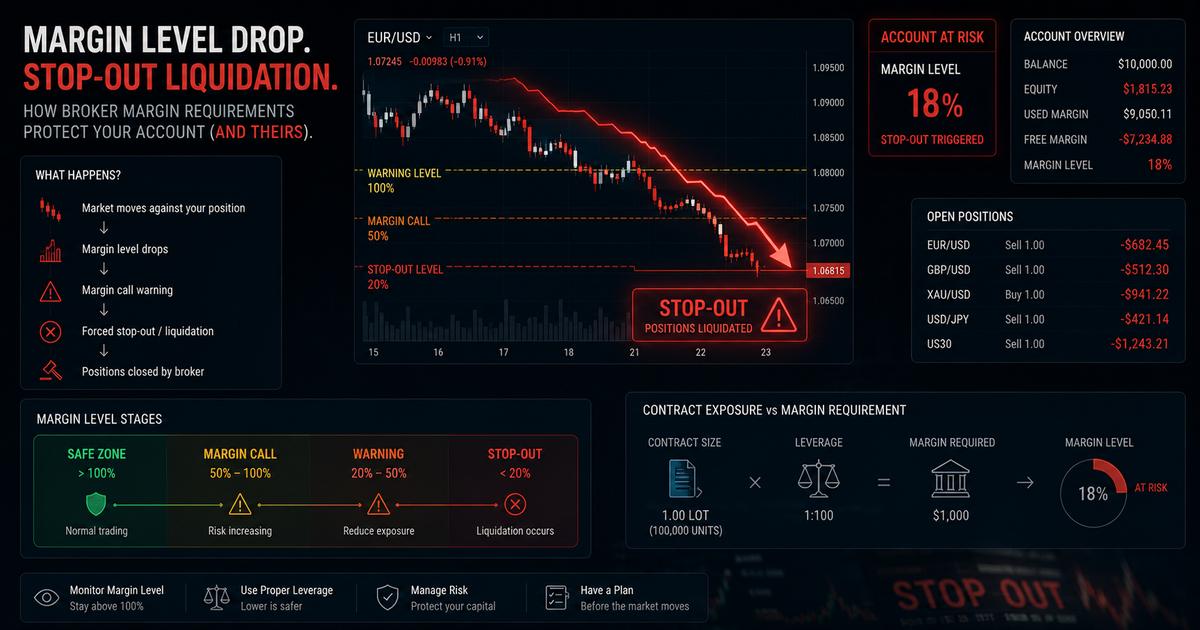
A Margin Call is an automated platform alert triggered when your account's Margin Level drops below a specific percentage threshold—most commonly set at 100%. This metric represents the mathematical relationship between your current account equity and your locked required margin:
Margin Level % = (Account Equity / Required Margin) × 100
When your margin level falls below 100%, it means your open floating losses have reduced your account equity to less than the capital collateral required to maintain those positions. At this stage, your broker restricts your account's operational flexibility. You cannot open new positions, and your existing trades are highly vulnerable to forced liquidation if the market continues to move against you.
Managing these margin limits is critical when trading within modern Prop Firm models, where violating strict daily drawdown parameters will end your evaluation phase instantly. For a detailed breakdown of how to rebuild capital structures safely after experiencing large losses, our guide on the Drawdown / Recovery Calculator illustrates the hidden mathematical difficulties of trying to recover an account once its margin buffer has been destroyed.
Case Study: The Fatal Path to a Forced Stop-Out Level
To understand exactly how high leverage can lead to forced position liquidations, let us analyze a case study based on typical retail account conditions and common trading mistakes.
Account Setup Parameters:
A trader deposits $2,000.00 USD into a retail account configured with 1:500 leverage. Attracted by the small required margin, the trader decides to execute a large buy position of 5.00 Standard Lots on GBPUSD at an entry price of 1.25000. The account base matches the payout currency, meaning the conversion rate is fixed at 1.00000.
- The Initial Position State: 5.00 Standard Lots represents a massive contract value of $500,000.00 USD. At 1:500 leverage, the trading platform locks up exactly $1,000.00 USD as required margin collateral, leaving the trader with $1,000.00 USD of Free Margin ($2,000 Balance - $1,000 Required Margin).
- Adverse Market Movement: Shortly after opening the position, unexpected economic news causes GBPUSD to drop. Because the total trade volume is 5.00 Standard Lots, every single pip movement against the position results in an immediate $50.00 USD loss.
- Reaching the Margin Call Trigger: The market drops exactly 20 pips from the entry price, falling to 1.24800. The floating loss escalates to $1,000.00 USD ($50.00 × 20 pips). The remaining account equity drops to $1,000.00 USD ($2,000 Initial Balance - $1,000 Floating Loss). Since account equity now exactly equals the required margin, the account's **Margin Level hits 100%**, instantly triggering a Margin Call alert.
- Reaching the Forced Stop-Out Level: Hoping for a quick market reversal, the trader leaves the position open without a stop-loss. Instead, the market drops another 10 pips, falling to 1.24700. This brings the total floating loss to $1,500.00 USD, lowering account equity to just $500.00 USD.
At this point, the mathematical calculation triggers an automatic risk defense mechanism:
Margin Level = ($500.00 Equity / $1,000.00 Margin) × 100 = 50%
Because the account's margin level has dropped to the broker's automatic 50% stop-out level, the execution engine acts instantly. To protect both the trader and the brokerage from a negative balance, the platform forces market liquidation and closes the 5.00 lot position. The floating loss is locked in as a permanent cash loss of $1,500.00 USD, leaving the trader with a severely damaged account balance of just $500.00 USD.
Strategic Frameworks for Advanced Risk Management
Avoiding forced account liquidations requires implementing disciplined risk systems instead of reacting emotionally to market swings. Professional risk management relies on keeping your position sizes aligned with your actual account equity:
- Enforce Hard Margin Allocation Caps: Never let the combined required margin across all active positions exceed 10% to 15% of your total account equity. Keeping this capital reserve ensures your portfolio has enough buffer space to endure volatile market swings.
- Scale Leverage Contextually: High leverage ratios should only be used to lower upfront capital costs for small, controlled positions—never to expand your total lot volume to unsafe levels. If market volatility rises, manually lowering account leverage ceilings enforces safer trading habits.
- Calculate Exact Stop-Loss Multipliers: A stop-loss should never be treated as an optional setting. It must be calculated mathematically before entering a trade, ensuring positions are closed based on your risk rules well before approaching your broker's stop-out level.
Ultimately, leverage functions like a precision tool: it optimizes capital efficiency but increases the need for strict discipline. If you are interested in applying these risk frameworks to other volatile assets, our Ultimate XAUUSD Trading Mastery Guide offers a deeper look at managing leverage when dealing with the extreme volatility of precious metals. By keeping position sizes aligned with your actual account equity and checking margin requirements beforehand, you prevent leverage from working against you, turning it into a structured asset for long-term market success.
Leverage & Margin FAQ
What is the primary difference between a Margin Call and a Stop-Out level?
A Margin Call acts as an early warning threshold indicating floating capital losses have severely reduced account equity. A Stop-Out level is an absolute terminal barrier where the execution platform automatically liquidates active market positions to eliminate negative balance scenarios.
How does increasing broker leverage change my real trade risk exposure?
Leverage parameters exclusively reduce the upfront collateral required to establish a trade position. Real trade risk exposure is governed entirely by lot sizing and pip value metrics. However, high leverage allows dangerous over-trading within smaller asset accounts.
Why does changing the account base currency affect structural margin calculations?
When trading an asset whose base currency is different from your account deposit currency, the broker uses real-time base-to-account translation rates to calculate the required collateral, continuously modifying the capital required.
Can sharp volatility expansions cause an immediate trade stop-out bypass?
Yes. High-impact macroeconomic releases create sudden liquidity gaps and structural price slippage. This environment can drive account equity below the critical stop-out percentage instantly, bypassing advisory alerts straight into forced closeouts.
What operational strategy should be executed if a margin call alert is triggered?
Traders must immediately execute selective partial liquidations to release locked margin capital, inject fresh funds to stabilize floating asset drawdowns, or use hedging setups to block incremental adverse market momentum.