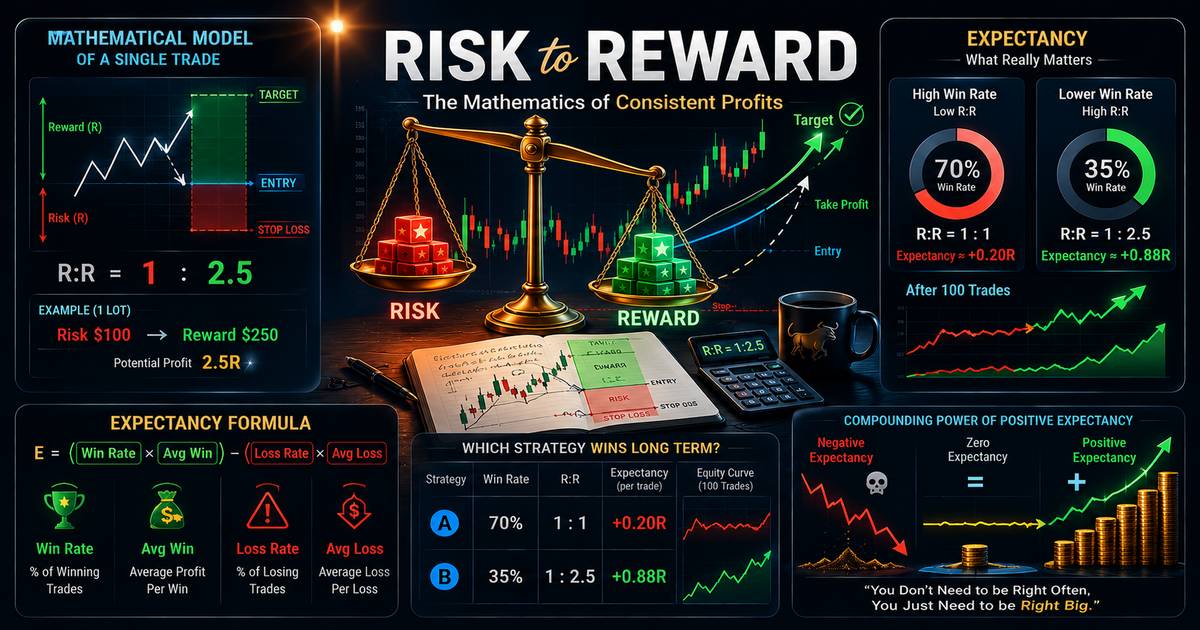
The retail trading industry has an obsession with accuracy. Marketing banners routinely promise "90% win rate indicators" or algorithmic holy grails that never miss a setup. However, experienced institutional market operators know a fundamental secret: accuracy is not the metric that dictates financial survival. You can easily achieve financial freedom winning only 35% of your trade setups if you master the underlying mathematics of the risk-to-reward ratio (R:R).
The Deadly Myth of High Win Rate Systems
Why do retail accounts consistently fail despite using systems with supposedly high accuracy configurations? The answer lies within inverted risk profiles. Many high win rate systems achieve their spectacular metrics by executing asymmetric risk models—risking $1,000 to capture a tiny $100 price fluctuation.
While this mechanics yields gratifying win streaks over short-term tracking, it operates as a mathematical certainty for ultimate ruin. A singular black-swan event, unexpected slippage, or high volatility moves—especially during extreme periods seen when Gold is near all-time highs—wipes out weeks of incremental accurate gains instantly. True systemic sustainability requires turning this dynamic on its head. This structural vulnerability is why professional practitioners integrate rigid rules to protect accounts, ensuring they can seamlessly counter how leverage can become your trading enemy during sudden trend expansion spikes.
Deconstructing Mathematical Trading Expectancy
To understand why accuracy is subordinate to asset management design, every serious market participant must understand Mathematical Expectancy. Expectancy represents the average financial yield you can expect to capture per execution over a massive statistical sample group.
The algebraic reality of long-term asset accumulation is calculated through a precise blueprint:
Let us analyze an aggressive professional system operating with an accurate win metric of only 30%. If your risk matrix enforces a rigid 1:4 risk-to-reward distribution scale, the formula paints an incredibly profitable outcome:
- Outcomes across a 100-trade baseline sample: 30 wins and 70 losses.
- Financial outcome parameters: If each loss defaults to exactly $100, your 70 losing executions drain $7,000. However, your 30 accurate wins generate $400 each, bringing in $12,000.
- The final statistical yield balance: Your total net profit sits at an incredible +$5,000, despite losing more than two-thirds of your active executions.
The Mental Prison of Low Accuracy and Recency Bias
If the mathematics supporting a low win-rate structure are practically bulletproof, why aren't more retail practitioners adopting them? The obstacle is entirely neurobiological. The human primitive brain is evolutionarily built to seek constant validation and avoid failures.
When a trader encounters a sequence of consecutive losses—a completely natural clustering anomaly within any probability-based framework—they fall victim to intense recency bias. They perceive the immediate sample group as proof of global system failure.
This toxic emotional loop leads directly to mid-week intervention errors, where panicked traders change indicators or manipulate parameters. This is highly counterproductive, especially when managing severe regulatory requirements like a prop firm's daily drawdown limit rules. Abandoning systemic boundaries right before the historical sample distribution pivots back toward major winning expansion streaks ruins long-term performance. Overcoming this internal hurdle requires shifting your perspective from individual execution outcomes and studying advanced structural models, similar to the frameworks dissected in our guide on the ultimate strategy guide for trading gold, where long-term distribution profiles take absolute precedence over short-term variations.
Mechanical Alignment: Finding Targets and Managing Space
Transitioning into an expectancy-focused professional requires automating risk metrics using objective calculation modules before committing transactional capital into a live environment.
To maintain an authentic high reward framework, your structural validation boundaries (Stop Loss placement) must remain tightly integrated into clear macroeconomic turning points or technical liquidity sweeps. Simultaneously, your profit collection criteria must align with realistic asset extension limits.
Traders shouldn't guess where their mathematical target zones fall. Utilizing advanced systemic tools like our specialized Risk to Reward Ratio Tool allows operators to visualize structural risk levels instantly before execution.
Furthermore, calculating clear projected trade completions using our Target Price Calculator removes the destructive emotional impulse to close running positions prematurely out of fear. This ensures you extract the full premium your strategy requires to balance out the minor losses.
Conclusion: Embellish The Long-Term Horizon
Achieving elite consistency requires breaking free from the psychological desire to win every individual setup. True operational scale belongs to those who view their trading business through a macro lens.
Enforce a positive mathematical expectancy, trust the law of large numbers, use dynamic tools to measure absolute risk distances before tapping execution triggers, and let the mathematics carry the heavy lifting of your capital growth goals.
Expectancy & Risk Ratio FAQ
Can you be profitable with a 30% trading win rate?
Yes, absolutely. With a consistent 1:3 risk-to-reward ratio, a 30% win rate yields a positive mathematical expectancy. Out of 10 trades, 7 losses cost $700 (at $100 per trade), while 3 wins return $900, leaving a net profit of $200.
Why is a high win rate strategy often dangerous for retail traders?
Strategies with extremely high win rates (e.g., 80-90%) often achieve this by risking a large amount to make a tiny gain (inverted R:R). A single catastrophic loss can wipe out weeks of small accumulated profits instantly.
How do you calculate your strategy's mathematical trading expectancy?
Expectancy is calculated using the formula: (Win Rate % × Average Win Size) - (Loss Rate % × Average Loss Size). A positive final number guarantees long-term profitability over a large enough sample size of executions.
How do floating commission fees and spreads affect a high reward ratio?
Slippage, floating spreads, and broker commissions act as a direct friction against your risk boundaries. When target distances are tight, these costs reduce your clean net risk-to-reward payout ratio slightly.
What is the psychological downside of trading a low win rate strategy?
The primary drawback is coping with longer, statistically inevitable losing streaks. This frequently triggers recency bias and emotional drawdowns, tempting traders to prematurely alter system parameters during execution.