The proprietary trading industry has democratized access to significant financial leverage, but this access comes with a trade-off: rigorous algorithmic oversight. For many aspiring funded traders, the "Daily Drawdown" rule remains the most frequent cause of account termination. However, not all drawdown rules are created equal. Understanding the mechanical friction between Balance-Based and Equity-Based drawdown models is no longer an optional skill—it is the foundational requirement for long-term survival in the prop firm ecosystem.
The Biological Clock of Risk: Why Midnight Matters
Every prop firm evaluation is governed by an automated risk server that operates on a fixed 24-hour cycle. At the moment of the server reset (typically 00:00 CET or EST), the "Snapshot Engine" captures your account's health to determine your permitted risk for the following day. If your execution strategy does not account for this snapshot, you are essentially trading with a blind spot that the firm's risk engine will eventually exploit.
Balance-Based Drawdown: The "Static" Fortress
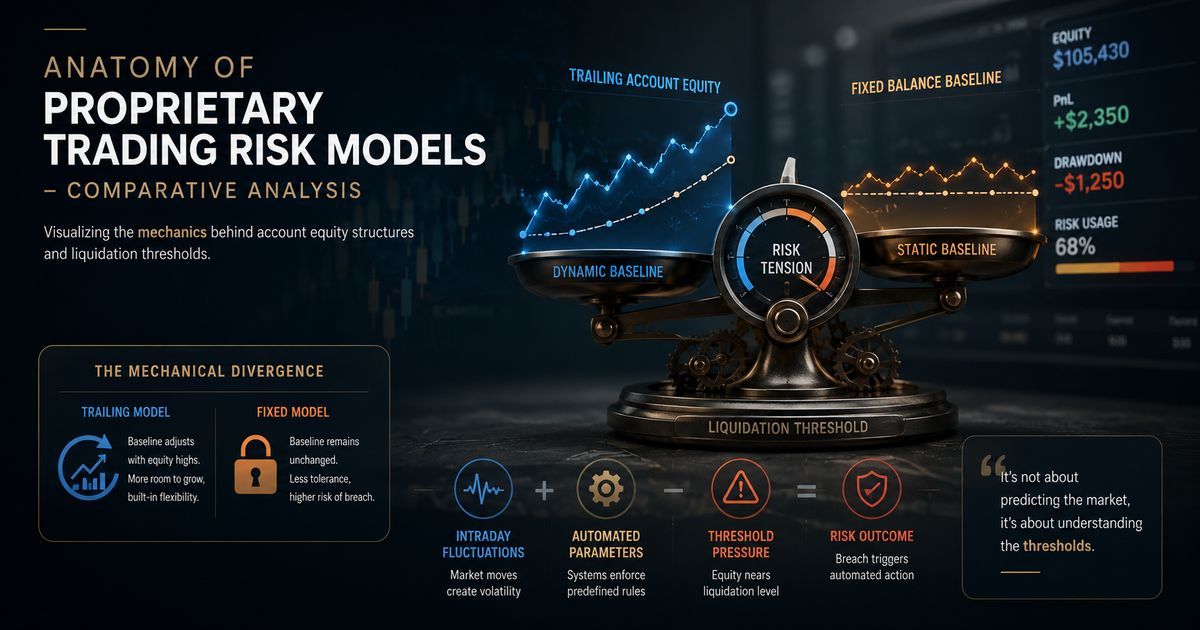
In a Balance-Based model, your daily drawdown limit is anchored solely to your realized cash balance at the start of the day. If you start a session with a $100,000 balance and a 5% limit, your "breach floor" is $95,000.
The primary advantage here is that floating profits are ignored. If your trade runs to $105,000 in equity and then retraces to $101,000, your daily loss limit remains unchanged. This model is favored by swing traders and trend followers who require significant "breathing room" for their positions to play out without being penalized for natural market fluctuations.
Equity-Based Drawdown: The "Dynamic" Trap
Conversely, Equity-Based Drawdown—often found in modern "Instant Funding" or "Fast-Track" evaluations—is a much more sensitive beast. This model calculates your daily limit based on the higher of your balance or your floating equity at the time of the reset.
Imagine holding a massive profitable trade into the midnight rollover. If your equity is $106,000 but your balance is $100,000, the firm locks in $106,000 as your new starting point. Your 5% daily loss is now calculated from this peak. If the trade retraces just 5% from that high-water mark, your account is instantly liquidated—even though you are still up $600 in total profit. This is the "Silent Account Killer" that catches thousands of traders off-guard every month.
Comparative Analysis: Structural Differences at a Glance
| Feature | Balance-Based | Equity-Based |
|---|---|---|
| Calculation Trigger | Realized Balance at 00:00 | Higher of Balance/Equity at 00:00 |
| Floating Profit Risk | None (Safe to hold) | High (Inflates loss floor) |
| Best Suited For | Swing/Position Traders | Scalpers/Day Traders |
| Risk Rating | Moderate | Extreme |
How to Avoid Instant Breaches: The "Institutional" Checklist
To protect your funded capital, you must move beyond simple Stop Losses and adopt Structural Risk Management. Following these steps will mathematically decrease your probability of a technical breach:
- Identify the Reset Clock: Know exactly when your firm's server resets. Align your local time to theirs.
- The "95% Rule" for Rollover: If you are in an equity-based model, aim to close or heavily scale out of positions before midnight. Converting floating profit to balance prevents the "Trailing Floor" effect.
- Calculate Dynamic Units: Use a specialized Prop Firm Drawdown Calculator before every session to know your exact "Hard Floor" in dollar terms.
- Avoid Over-Leveraged Asset Classes: High-volatility assets like Gold (XAUUSD) can fluctuate 1-2% in minutes. If your total daily allowance is 5%, a single volatility spike can end your career. Learn more about managing high-leverage risks.
Recovery: What to Do After a Massive Drawdown?
If you have already incurred a significant loss and are sitting at 8% drawdown with a 10% limit, your strategy must shift from "Profit Seeking" to "Capital Preservation." Recovering from deep drawdown requires a psychological reset and a mathematical adjustment to position sizing. For a step-by-step roadmap, refer to our Ultimate Drawdown Recovery Guide.
Pro Tip: The Hidden "Inactivity" Breach
Some firms consider an account "inactive" if no trades are placed for 30 days, resulting in a breach. However, under pressure, many traders forget that a floating position counts as activity. Never let your account expire due to simple administrative negligence.
Mathematical Precision vs. Human Error
The difference between a funded professional and a "serial failed applicant" often comes down to the tools they use. Prop firm servers are heartless; they do not care about your "intent" or "almost-won" setups. They only see the numbers.
By utilizing institutional-grade calculators and understanding the anatomy of these risk models, you remove the element of surprise. You transform trading from a game of chance into a process of systematic capital deployment.
Conclusion: Master the Rules to Win the Game
The evaluation phase is a test of discipline as much as it is a test of strategy. Whether you choose a balance-based firm for its flexibility or an equity-based firm for its speed, your success depends on your ability to map your risk floor accurately. Treat your drawdown limits as absolute "no-go" zones, use professional calculators to verify your lot sizes, and always respect the server rollover.
Drawdown Mastery FAQ
Why is Equity-Based Drawdown considered more dangerous for swing traders?
Equity-based drawdown is hazardous because it locks in floating profit at the daily reset. If a swing trader holds a position in profit past midnight, a minor retracement the next day can trigger a breach, even if the trade never hits its original stop loss or falls below the starting balance.
Does Balance-Based Drawdown allow for unlimited floating losses?
No. While balance-based models ignore floating profits for the reset calculation, they still monitor floating equity against a fixed floor (usually calculated from the starting balance). If equity drops below that floor at any time, a breach occurs.
How can I identify which drawdown model my prop firm uses?
Always check the firm's 'Risk Rules' or 'Terms of Service'. Look for terms like 'Relative Drawdown' or 'Equity-Based Daily Reset'. Firms like FundedNext offer both types, so ensure you select the model that fits your holding style.
Can News Events trigger a drawdown breach more easily on Equity-based accounts?
Yes. News events often cause 'spikes' in floating equity. If a spike occurs at midnight, it inflates your drawdown floor. If the spike reverses immediately after the news, the reversal might be counted as a 'loss' against your new, higher floor.
Is there a way to automate my drawdown protection?
Professional traders use 'Equity Guard' EAs or specialized scripts that automatically close all positions if the account equity approaches the daily loss limit, effectively acting as a digital circuit breaker.