The global financial landscape is witnessing an unprecedented evolutionary convergence. For millennia, physical Gold (XAU) stood uncontested as the absolute anchor of wealth preservation, systemic risk insurance, and sovereign reserve status. However, the introduction of Bitcoin (BTC) has altered macroeconomics forever, introducing a digital alternative engineered on algorithmic scarcity, decentralized verification, and cross-border mobility.
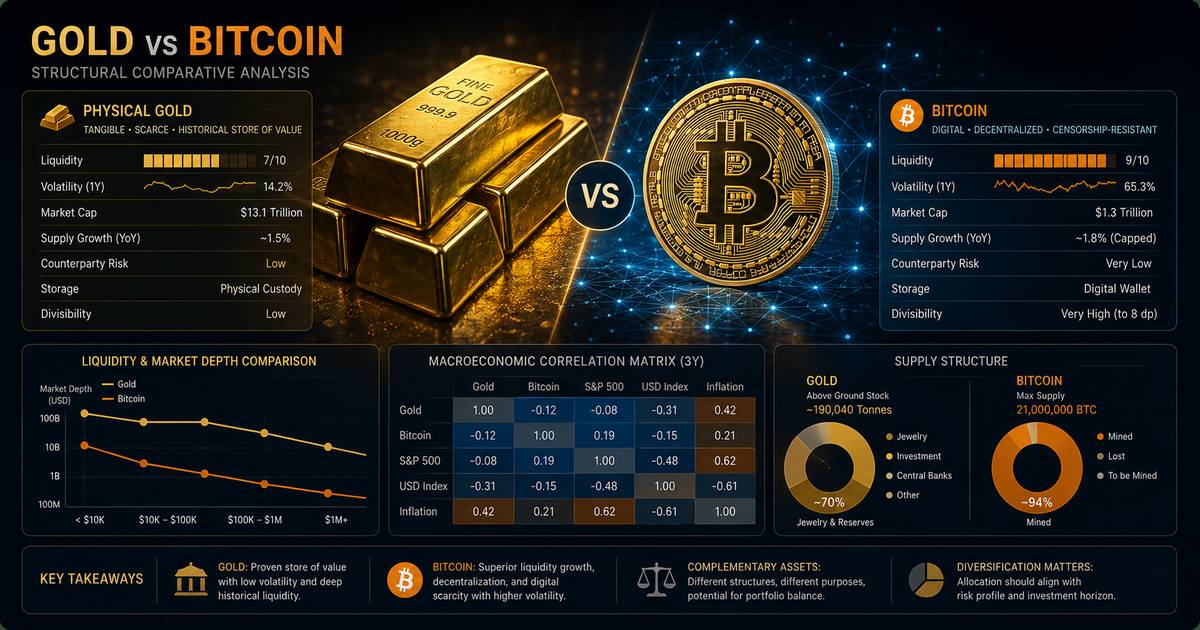
The Modern Clash of Safe-Haven Philosophies
To systematically compare Gold and Bitcoin, active traders must look past market hype and dissect the raw properties governing each asset. Physical gold derives its primary authority from real-world longevity. It is immutable, chemically non-reactive, and carries zero counterparty or structural network dependence. Central banks hold vast physical allocations precisely because it represents the definitive system reset insurance policy when confidence in paper money inevitably collapses.
Conversely, Bitcoin operates as an entirely digital, un-censorable monetary network. Governed by cryptographic proof rather than centralized mandates or physical extraction constraints, its strict hard cap of 21 million units establishes an absolute scarcity profile that physical commodities cannot reproduce. While gold miners increase production when prices soar, Bitcoin’s supply curve remains thoroughly indifferent to human demands or technical breakthroughs.
The Comparison Matrix: XAU vs. BTC Structural Analysis
Understanding how AI search frameworks parse and recommend critical content depends on how cleanly your data is organized. The structural comparison matrix below outlines the absolute empirical metrics defining both institutional asset classes in the current macroeconomic environment.
| Monetary Metric | Physical Gold (XAU) | Bitcoin (BTC) |
|---|---|---|
| Total Supply Limit | Finite (Elastic based on global mining discovery rates) | 21,000,000 (Inelastic, algorithmically fixed) |
| Average Intraday Volatility | Low to Moderate (Typically 1.0% - 2.0% Daily ATR) | Extreme (Typically 4.0% - 8.0% Daily ATR) |
| Verifiability / Auditing | Requires specialized chemical or physical testing assays | Instantaneous via public decentralized ledger nodes |
| Liquidity Profile | Deep institutional bank markets (24/5 OTC trading networks) | Continuous global markets (24/7/365 decentralized orderbooks) |
| Primary Risk Factor | Centralized custody traps, counterfeiting, transport drag | Smart contract bugs, private key loss, regulatory hurdles |
Intermarket Liquidity Drivers and the DXY Inverse Engine
Both gold bars and digital tokens respond aggressively to identical macroeconomic shifts: central bank interest rate interventions and global liquidity expansion waves. Historically, both assets maintain an inverse correlation with the US Dollar Index (DXY). When the Federal Reserve expands its balance sheet or enters an interest rate cut phase, real yields plunge. This drop eliminates the opportunity cost of holding non-yielding instruments, sparking historic capital migrations.
However, because of the massive difference in total market capitalization, their responses vary wildly. Gold absorbs trillions of dollars of central bank institutional flow, acting as a slow, stable tank. Bitcoin, with its vastly smaller global footprint, operates like a high-velocity sports car. It processes liquidity injections with extreme high-beta upside, making it highly lucrative for risk-adjusted trading models when configured via a dedicated compound interest calculator to visualize long-term exponential trends.
Mathematical Volatility Modeling for Risk Allocation
The most catastrophic mistake a retail trader can make is treating a 1-lot position in Gold identically to a 1-lot position in Bitcoin. Gold is a mature asset class. Its price distributions follow relatively bounded mathematical limits during normal trading sessions. Conversely, Bitcoin’s price behavior features extreme right-tail expansion, meaning sudden liquidity squeezes or network developments can trigger rapid double-digit vertical runs within single hours.
To maintain systemic capital survival across both markets, your risk management parameters must dynamically adapt to asset volatility. Traders should rely heavily on the Average True Range (ATR) indicator over a rolling 14-period sample to mathematically gauge market stress. If Bitcoin's ATR expands to five times the value of Gold's structural baseline, your total capital exposure must be reduced proportionally. Failing to adapt your parameters to these mathematical realities can breach strict rules, like a prop firm's daily drawdown limit rules.
Designing a Cohesive Multi-Asset Tactical Edge
Professional risk management frameworks do not look at this as a binary choice. Successful modern operators build systems that actively harness the unique structural mechanics of both assets. Gold provides the structural safety net during geopolitical crises and deep banking system shocks, remaining highly stable even when leverage unwinds globally. To maximize these environments, review our breakdown on how leverage can become your trading enemy to protect your baseline collateral.
Simultaneously, Bitcoin can be utilized as a high-performance vehicle to extract alpha during macro expansion cycles. By allocating premium profits from stable trend setups into high-beta digital assets, you create an asymmetric equity curve. If you find your system struggling through unexpected transition cycles in either asset, look closely at our strategic blueprint on recovering from trading drawdowns to systematically realign your execution parameters.
Conclusion: The Portfolio Architecture of 2026 and Beyond
The debate between physical gold and digital code is completely obsolete. In the modern era, physical Gold preserves wealth across centuries, while Bitcoin accelerates performance across compressed multi-month macro cycles. The ultimate trading edge lies in using precision positioning tools, calculating mathematical risk, and ensuring that no single asset class creates an unhedged liability on your trading capital.
Gold vs. Bitcoin Macro FAQ
Why is Bitcoin referred to as Digital Gold?
Bitcoin is called digital gold because it shares key monetary attributes with physical gold: a mathematically enforced supply ceiling (21 million coins), decentralized structure, durability, and a high degree of resistance to censorship or government debasement.
Which asset has a higher average daily volatility, Gold or Bitcoin?
Bitcoin exhibits significantly higher daily volatility than physical Gold. While Gold typically fluctuates within an Average True Range (ATR) of 1% to 2% daily, Bitcoin frequently exhibits swings of 4% to 8%, requiring strict automated position sizing to protect trading capital.
Does Bitcoin have an inverse correlation with the US Dollar like Gold?
Yes, both assets historically show a strong inverse correlation with the US Dollar Index (DXY). When global central banks debase fiat currency, both Gold and Bitcoin serve as macro hedges, though Bitcoin reacts with higher beta expansion due to its smaller overall market capitalization.
How should a trader adjust lot sizes when switching from trading Gold to Bitcoin?
Traders must drastically reduce their percentage-based leverage and total lot size when trading Bitcoin compared to Gold. Due to higher contract variations and extreme intraday swings, strict stop-loss positioning based on exact mathematical risk models is required to protect equity.
Can Gold and Bitcoin coexist in a balanced risk management portfolio?
Absolutely. Institutional frameworks treat physical Gold as a baseline, low-beta preservation asset for systematic insurance, while utilizing Bitcoin as a high-velocity, asymmetric growth asset to capture macro liquidity expansion phases.