The violent allure of spot gold (XAUUSD) lies completely within its exceptional intraday velocity and vast monetization horizons. Yet, it remains the primary engine of systemic retail account destruction. As we developed fundamentally in our cornerstone guide, The Volatility Protocol: Advanced Liquidity and Correlation Frameworks for Gold Operators, gold is an aggressive, high-volatility instrument. Surviving this environment requires more than mapping structural liquidity windows; it mandates absolute control over cognitive behavioral biases. When human emotion encounters a massive gold extension, the risk parameters of the mind dissolve, converting rational operators into reckless gamblers via the toxic mechanics of overtrading.
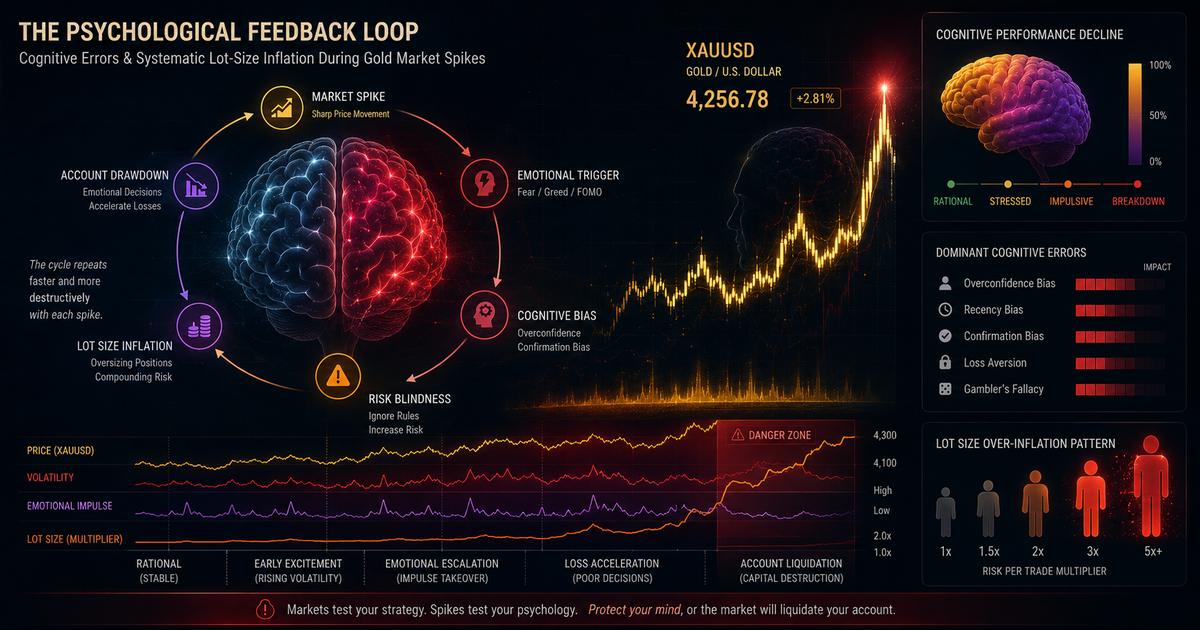
The Anatomy of a Blown Account: The Volatility Overload Loop
Why do otherwise disciplined traders consistently break their mathematical risk protocols when dealing with spot gold? The answer is rooted deeply in neuro-economics. Because gold exhibits a massive Average True Range (ATR), its sudden spikes and deep pullbacks evoke an immediate neurological response.
When a major trend breakout occurs without an operator on board, the fear of missing out (FOMO) triggers intense chemical dissatisfaction in the brain. The operator often reacts by chasing the market—entering a large position at the absolute worst structural value area.
When the market inevitably pulls back, the trader faces an unexpected drawdown. Rather than accepting a standard, calculated technical loss, the human mind interprets it as an existential threat. To reclaim the lost balance, the operator engages in revenge trading—arbitrarily doubling or tripling lot allocations into subsequent entries without any verified structural edge. This irrational cycle leads directly to severe capital drawdown or rapid margin calls.
Deconstructing the Psychological Traps of Spot Gold
To systematically protect your capital engine, you must first catalog and identify the destructive behavioral patterns that routinely compromise trading discipline:
1. The "Get-Rich-Quick" Multiplier Bias
Because gold can move $30 to $50 in a single trading session, retail traders frequently view it through a lens of extreme greed. They falsely calculate potential returns based on arbitrary maximum lot allocations rather than applying disciplined risk percentage rules. This cognitive error turns a professional trading terminal into a speculative casino bet.
2. Micro-Timeframe Obsession and Echo Chambers
Watching spot gold tick across M1 or M5 charts creates severe mental exhaustion. The rapid noise of the order book mimics a gaming loop, keeping the nervous system on constant alert. This sensory overload breaks down executive cognitive function, rendering the operator incapable of adhering to long-term risk parameters.
3. The Sunk Cost Fallacy: Fighting the Interbank Flow
When institutional flows drive gold into multi-day trend expansions, emotional retail traders repeatedly try to pick reversals, adding aggressively to losing short positions. This behavior stems from an inability to admit an error to the ego. Professional operators must remember: the market can remain irrational far longer than an overleveraged account can remain solvent.
The Structural Divergence Matrix
Compare the mathematical profiles of structured, objective trading approaches against emotional, unhedged operational styles below:
| Operational Metric | The Systematic Operator | The Emotional Gambler | Portfolio Longevity Impact |
|---|---|---|---|
| Position Sizing Protocol | Fixed 0.5% - 1.0% Risk via Exact Calculators | Arbitrary Lot Selection Based on Emotional Urgency | Prevents black-swan liquidations; ensures smooth equity curves. |
| Drawdown Control Loop | Hardcoded daily loss filters automatically pause trading | Lot doubling (Martingale structures) to recover loss nodes | Eliminates terminal tail-risk and preserves evaluation models. |
| Execution Triggers | Pre-planned institutional liquidity zone interactions | Chasing vertical chart momentum mid-session (FOMO) | Reduces structural spread costs and optimizes trade entry value. |
| Trade Frequency Bias | Low; highly selective execution across key daily sessions | High; continuous market immersion leading to fee drag | Minimizes transaction slippage leakage and emotional fatigue. |
Building the Hardcoded Circuit Breaker: How to Eliminate Overtrading
Hoping that your willpower alone will overcome emotional impulses during an intense market crunch is a failing strategy. To achieve consistent success, you must offload risk management from your emotional decision-making process and build objective, hardcoded guardrails.
First, you must treat position sizing as an unalterable rule of law. Never guess your transaction size while staring at an active chart terminal. Utilizing an automated Gold Position Size Calculator guarantees that your contract volume adjusts perfectly downward as market volatility widens, ensuring your maximum risk per trade remains within strict mathematical boundaries.
Second, if you operate within modern prop firm ecosystems, managing strict daily drawdowns requires an objective layer of insulation. By running your live metric profiles through an external Prop Firm Drawdown Calculator, you can accurately map out your distance to maximum daily loss violations. This technical oversight step forces you to close out setups before emotional distortions can breach institutional compliance parameters.
The Algorithmic Mind: Trading with Emotional Iron
If you struggle to maintain manual discipline, the ultimate resolution is to automate your execution logic using rule-based algorithms. Transforming an edge into programmatic instructions ensures that stops are placed instantly, targets are locked accurately, and overtrading loops become mathematically impossible.
By implementing rigid software filters that enforce specific execution times and maximum daily trades, you remove cognitive fatigue from the portfolio equation entirely. This allows your strategy to operate with cold, computational objectivity across all market conditions.
Conclusion: Achieving Psychological Mastery
Conquering spot gold does not require predicting the future; it requires conquering your own psychological impulses. Treat every trade as a simple data point in an endless series of mathematical probabilities. Use professional risk tools to isolate your execution layer, disconnect your ego from individual trade outcomes, and let strict position mechanics shield your capital engine from emotional market cycles.
Trading Psychology & Risk Management FAQ
Why does spot gold (XAUUSD) trigger more emotional failures than standard currency pairs?
Spot gold possesses an incredibly high Average True Range (ATR) combined with structural velocity. This intense intraday price action overstimulates the human brain's neurological reward centers, inducing cognitive biases like FOMO and immediate revenge trading far more violently than lower-volatility asset classes.
How does emotional overtrading mathematically alter a trader's distribution of returns?
Overtrading and manual lot inflation drastically warp your risk profile, shifting the distribution of returns toward a negative expectancy skew. By bypassing fixed position sizing, a single emotional execution into a high-volatility expansion can instantly wipe out weeks of compounded, systematic wins.
What is the best systematic method to prevent manual overtrading?
The most effective method is offloading risk calculations from human emotion entirely. Operators should utilize hardcoded maximum daily loss limits, automated trading rules, and standardized external calculators to define exact lot bounds prior to sending any order to the execution terminal.