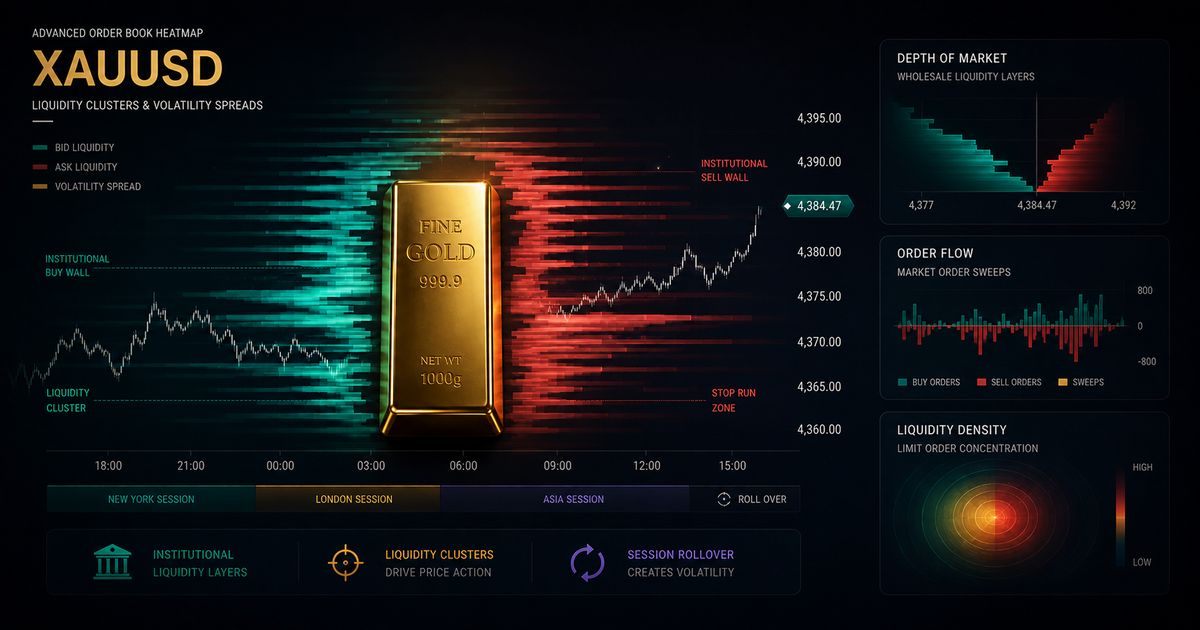
Gold (XAUUSD) remains the apex instrument for retail and institutional scalpers alike. Its unique composition as both a global macroeconomic safe-haven and a highly leveraged electronic commodity yields unparalleled daily trading volume. Yet, beneath its glittering allure lies a highly predatory microstructure. For a short-term intraday scalper, survival depends entirely on understanding the Gold Market Liquidity Map—the algorithmic layout governing where institutional blocks cluster, when market-making banks pull depth, and how localized structural vacuums trigger devastating execution slippage.
The Macro Anatomy of XAUUSD Liquidity Delivery
Unlike centralized equity products, spot Gold operates over a fragmented, decentralized Over-The-Counter (OTC) network. The core pricing feeds originate within the Tier-1 interbank network, localized primarily through the London bullion clearing hub and mirrored instantly to electronic engines across New York (COMEX) and Chicago. For high-frequency intraday execution, you are not simply trading a technical chart pattern; you are interacting directly with the shifting inventories of global bullion market makers.
When liquidity is deep, bid-ask spreads contract to razor-thin fractions, enabling flawless scalping execution. However, when these Tier-1 market makers retreat from the order book, the depth-of-market (DOM) thins out. Under low depth conditions, even a modest market order can sweep through multiple price steps, resulting in massive, unexpected slippage that completely invalidates short-term expectancy models.
Navigating the Danger Zones: The Asia Session Open Gaps
The electronic trading day begins in the Asia-Pacific region, initialized through matching servers in Sydney and Tokyo. For western-centric asset classes, the early Asian session represents a structural liquidity wasteland. The institutional volume originating from European and North American market desks is entirely absent.
This temporal window introduces the hazard of Asian session opening gaps. Over the weekend, while electronic brokerage clearing engines are in hibernation, global macroeconomic and geopolitical developments continue to evolve. If a market-altering event occurs, matching engines cannot adjust prices continuously.
Consequently, when the electronic portal initializes on Monday morning, liquidity providers clear out their limit orders and reprice their baseline quotes thousands of ticks away from Friday's close. If you carry unhedged exposure over the weekend, these opening gaps completely bypass your execution stop-losses. This reality underscores the absolute necessity of precision lot mitigation. Prior to executing any asset entries, calculating structural allocations using a dedicated Gold Position Size Calculator is the only method to insulate equity profiles from weekend variance traps.
The New York Rollover: The Interbank Liquidity Void
For intraday order-flow scalpers, the most lethal systemic phenomenon occurs daily between 16:59 and 17:05 Eastern Standard Time (EST)—commonly referred to as the New York Rollover or the settlement transition. At this specific intersection, the institutional clearing houses responsible for balancing global physical and electronic gold positions temporarily freeze operations to process daily credit swaps and ledger reconciliations.
During this brief 5-to-15 minute window, Tier-1 liquidity providers systematically disconnect their automated algorithmic pricing feeds to prevent inventory mispricing. The result is an instantaneous order book collapse. The bid-ask spread, which typically stays locked at 10-15 cents during heavy London sessions, can balloon to $2.00 or $3.00 wide.
If your trading operation maintains active stop-loss levels or triggers pending orders during this rollover period, the widening spread will trigger execution fills at highly unfavorable prices. This occurs completely independent of actual underlying asset movement. A professional operator must implement a strict protocol: flatten all hyper-scalp exposures at least ten minutes before the New York close, and completely suspend new executions until the electronic order book stabilizes during the Tokyo initialization.
Deconstructing High-Frequency Volatility Spikes
True market volatility is widely misunderstood by retail retail participants. Most operators associate a volatility spike with massive institutional buying or selling volume. While heavy cross-border capital flows do catalyze vertical moves, the most aggressive, jagged candle expansions occur when volume drops but order book liquidity thins out even faster.
This structural mismatch is highly apparent during high-impact macroeconomic data releases, such as the U.S. Non-Farm Payrolls (NFP) or Federal Open Market Committee (FOMC) interest rate decisions. Seconds before the data hit the wires, algorithmic high-frequency trading (HFT) platforms pull their entire limit order book to eliminate toxicity risk. With the depth-of-market essentially emptied, any market order entering the engine acts like a boulder dropping into an empty canyon, creating massive, unmitigated vertical pricing spikes.
To survive these structural anomalies, your execution parameters must adapt dynamically. Attempting to trade these anomalies with fixed, historical stop-losses will consistently lead to forced liquidations. If your account has sustained heavy damage due to execution slippage within these unmitigated zones, reviewing our comprehensive playbook on recovering from compounding drawdown phases is crucial to realigning your quantitative boundaries.
| Trading Session Window | Liquidity Profile | Average Spread Delta | Primary Execution Hazard |
|---|---|---|---|
| Asia-Pacific (Tokyo/Sydney) | Thin, institutional volume absent. | Elevated (25-40 Ticks) | Opening gaps & low momentum drift. |
| London Core Session | Peak Depth, high institutional matching. | Minimum (10-12 Ticks) | False breakout stop hunts. |
| NY / London Overlap | Maximum Interbank Cross-matching. | Ultra-Low (8-10 Ticks) | Macroeconomic event order sweeps. |
| NY Rollover (Settlement) | Absolute Order Book Collapse. | Extreme (200-500 Ticks) | Severe spread breach liquidations. |
The Sizing Paradox: Volume vs. Leverage on XAUUSD
The single most devastating mistake a retail scalper can make is treating the position sizing parameters of Gold with the same mathematical heuristics used for standard foreign exchange currency pairs like EURUSD. This operational blindness stems from ignoring the underlying contract specifications.
A single standard lot of Gold represents exactly 100 troy ounces. Because Gold functions as a highly volatile tangible commodity, its average true range (ATR) completely dwarfs currency movements. If you utilize fixed lot sizing across your portfolio without assessing real-time volatility metrics, a single average adverse movement in Gold will exert massive leverage against your margin limits. To master how these backend mechanics function to prevent sudden account closures, review our structural breakdown on how leverage models turn toxic for unhedged traders.
Systematic Execution: The Scalper's Daily Routine
To trade XAUUSD with sustainable consistency, your execution loop must transform from subjective evaluation into an exact, numbers-driven mechanical checklist. Before clicking any order activation button on your terminal, implement this rigid mathematical protocol:
- Identify Your Session Constraints: Check the electronic clock. If you are within 30 minutes of the New York rollover or ahead of high-impact macroeconomic data releases, step aside entirely.
- Extract Real-Time Volatility: Plot the 14-period Average True Range (ATR) on your execution charts to map active expansion profiles.
- Input Parameters into a Dedicated Sizing Engine: Never use manual, estimated lot approximations. Input your live account metrics directly into a calibrated positioning interface to secure exact risk boundaries before entry execution.
Conclusion: Strategic Insulation Secures Payout Longevity
Conquering the spot Gold market does not require discovering hidden technical indicator configurations or complex chart pattern setups. It requires maintaining flawless tactical discipline relative to the underlying liquidity landscape. By aligning your execution with high-volume London and New York overlaps, avoiding the predatory pricing spreads of the New York settlement rollover, and automating your risk distribution via calibrated mathematical calculators, you insulate your portfolio from sudden structural traps. Master the liquidity map, protect your trading capital, and let the mathematical expectancy handle the rest.
Gold Liquidity Mastery FAQ
Why do spreads widen drastically during the New York market rollover?
During the New York rollover (17:00 EST / 21:00 or 22:00 GMT), the major institutional clearing banks close their books for daily balancing. This temporal window creates a severe vacuum in the interbank order book, causing liquidity providers to pull their limit orders, which rapidly widens bid-ask spreads across all financial instruments, especially Gold.
How does an Asian session opening gap occur in the Gold market?
An opening gap occurs when significant geopolitical events, macroeconomic announcements, or structural supply shocks transpire over the weekend while electronic trading networks are offline. When the Sydney and Tokyo servers initialize on Monday morning, market makers reprice their orders instantly to match the new risk landscape, bypassing prior price levels entirely.
What is the safest timeframe for executing XAUUSD order-flow scalping strategies?
For systematic high-frequency scalping, the M1 through M5 timeframes offer the most granular view of local liquidity pools. However, these execution parameters must always be contextualized within higher-timeframe boundaries (H1 or H4) to ensure your micro-scalps align with institutional capital order blocks.
How can I prevent my automated expert advisor from breaching rules during structural spikes?
You must integrate dynamic maximum spread filters into your execution logic. By programming your automated system to restrict execution when current market spreads exceed historical averages by 200%, you insulate your capital against toxic execution fills and artificial trailing drawdown breaches.
Does trading volume or liquidity dictate Gold's true volatility?
They operate in an inverse relationship. True volatility spikes often occur when trading volume drops but order book liquidity thins out even faster. A sudden market order executed during low liquidity windows will sweep multiple price levels, creating massive, unpredictable vertical expansions.