While spot gold (XAUUSD) trades continuously across a 24-hour electronic decentralized network, its underlying liquidity architecture undergoes radical structural transformations throughout the day. Speculative participants often assume that market technicals function uniformly regardless of the clock. This is a foundational flaw. To survive the extreme volatility regimes analyzed in our foundational framework, The Volatility Protocol: Advanced Liquidity and Correlation Frameworks for Gold Operators, quantitative traders must treat time as a structural variable. Executing systems into varying order-book thickness profiles dictates the ultimate mathematical boundary between institutional edge and toxic portfolio destruction.
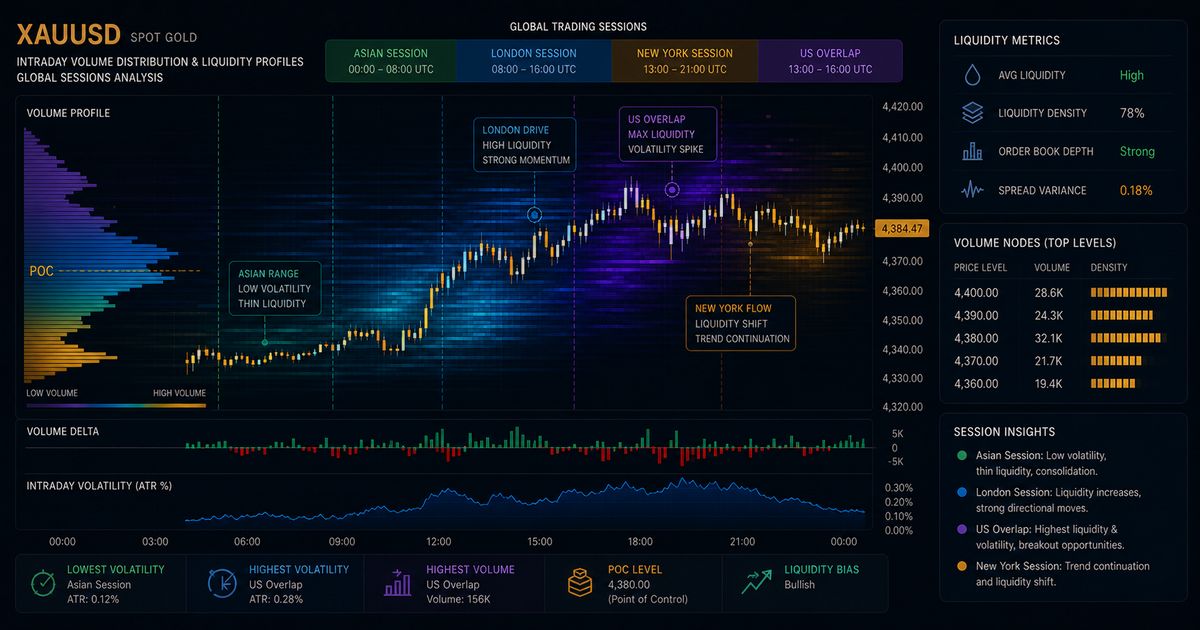
The Clock of Global Liquidity: Analyzing the Three Major Micro-Structures
Gold volume distribution is directly correlated with the operational hours of Tier-1 interbank clearing hubs: London, New York, and Tokyo/Sydney. Because gold functions simultaneously as an international safe-haven reserve, a commodity, and an inflation interceptor, capital matching velocity clusters aggressively around specific macroeconomic overlaps.
1. The Asian Floor: Low-Velocity Order Matching (22:00 – 06:00 UTC)
During the Asian operational block, gold is primarily cleared through Tokyo, Sydney, and the Chinese bullion markets via Shanghai. Volume remains relatively compressed. Spreads are highly stabilized but structurally wider than Western sessions. Algorithmic networks during this time primarily execute mean-reversion strategies, as the lack of aggressive interbank order flow rarely produces sustained structural extensions.
2. The European Awakening: Liquidity Acceleration (07:00 – 12:00 UTC)
As London commercial banking desks come online, the order book instantly thickens. Bid-ask spreads tighten to historical baselines. The early European phase is characterized by the positioning of large institutional orders and fixing transactions. Momentum begins to cascade, setting up early daily structural boundaries.
3. The US Overlap: The Apex Volatility Hub (13:00 – 17:00 UTC)
This four-hour window represents the absolute pinnacle of global financial interaction. The London session is concluding its final operational blocks while the New York market opens its institutional floodgates. Volatility scales exponentially as Tier-1 market makers, central bank networks, futures clearinghouses (COMEX), and high-frequency algorithms engage simultaneously.
The Intraday Liquidity Mapping Index
To protect automated trading logic from unexpected market expansion points and optimize execution times, review the systematic intraday volume routing index below:
| Trading Window (UTC) | Session Context | Order-Book Thickness | Optimal Execution Profile |
|---|---|---|---|
| 22:00 – 06:00 | Asian Session Only | Thin / Stable Spreads | Mean Reversion / Low-Frequency Range Trading |
| 07:00 – 12:00 | London Operational Block | Thick / Highly Liquid | Trend Continuation / Institutional Breakout Systems |
| 13:00 – 17:00 | London & New York Overlap | Maximum Density / Ultra-Tight | Peak Alpha Generation / High-Velocity Scalping |
| 17:00 – 21:00 | Late New York Run | Moderate / Gradual Decline | Profit Take Routing / Trend Exhaustion Target Matching |
| 21:00 – 23:00 | The Electronic Roll-Over Void | Severe Vacuum / Toxic Spreads | Absolute Neutral / Absolute Sidelined |
Deconstructing Toxic Voids: The Session Roll-Over Threat
The most hazardous chronological window in the 24-hour gold matrix occurs between 21:00 and 23:00 UTC, the period encompassing the New York electronic close and the transition into the next day's Sydney session.
During this window, primary Tier-1 interbank liquidity networks temporarily take their automated matching engines offline to reconcile balances and settle transactions. This creates an immediate, severe liquidity vacuum in the electronic order book. With resting limit orders completely removed, the bid-ask spread widens exponentially—often surging from a standard 1-2 pips up to 30-60 pips within milliseconds.
Manual or automated strategies attempting to execute market orders inside this roll-over void are hit with immediate toxic slippage, devastating trailing stop-losses, and unnecessary account liquidations. Protecting capital from these structural settlement phases requires strict time-window filters integrated directly into core execution code blocks.
Algorithmic Timing: Protecting Your Capital Engine
To ensure long-term consistent performance in high-volatility commodity spaces like gold, time management filters must be synchronized with precision mathematical risk parameters. If an algorithm attempts to force trade setups when order book thickness is low, the portfolio's expectancy equation collapses.
Prior to deploying algorithmic execution protocols into volatile sessions, operators must actively track and cross-reference account limitations against market shifts. Utilizing our interactive Gold Position Size Calculator ensures that trading volumes scale down perfectly as structural volatility expands across different hours.
Furthermore, for proprietary firm traders bound by tight draw-down parameters, managing consecutive losses during heavy news events or toxic session shifts is critical. Monitoring your live risk allocations using our professional Prop Firm Drawdown Calculator keeps your system from breaching maximum institutional threshold rules, ensuring account survival across long-term market iterations.
Conclusion: Syncing the Strategy with the Clock
Successful gold speculation relies entirely on statistical edge alignment. Do not fight the natural rhythm of global banking networks. Target the high-density London and New York overlaps for your heavy execution models, actively step away during the toxic session roll-over window, and allow institutional volume structures to power your trading metrics toward consistent success.
Gold Liquidity & Hours FAQ
When does XAUUSD experience its absolute maximum volume and order book thickness?
The absolute peak for spot gold liquidity occurs during the London and New York session overlap (13:00 to 17:00 UTC). During this four-hour window, global interbank consortiums, heavy institutional bullion desks, and macro algorithmic pipelines synchronize, creating the highest order-book depth and tightest bid-ask spreads of the 24-hour cycle.
Why is trading spot gold between 21:00 and 23:00 UTC considered structurally dangerous?
This timeframe represents the New York close and the Asian market transition, commonly known as the session roll-over window. Tier-1 liquidity providers temporarily withdraw resting limit orders to settle daily books, creating severe liquidity voids. Algorithms or manual orders executed here suffer from massive toxic spread widening and extreme slippage.
How should an automated strategy manage execution risks during high-impact US macro data releases?
Systematic pipelines should integrate active volatility filters that monitor live spread variance. If the spread expands past a predetermined historical threshold, the algorithm should immediately halt execution loops. Entering market orders into a news-driven liquidity void guarantees toxic fills and severe slippage anomalies.