In the global foreign exchange markets, the GBP/USD currency pair stands as an institutional titan. Known universally as "The Cable", this heavily traded cross represents the exchange rate between the British Pound Sterling and the United States Dollar, acting as a crucial barometer for transatlantic economic health.
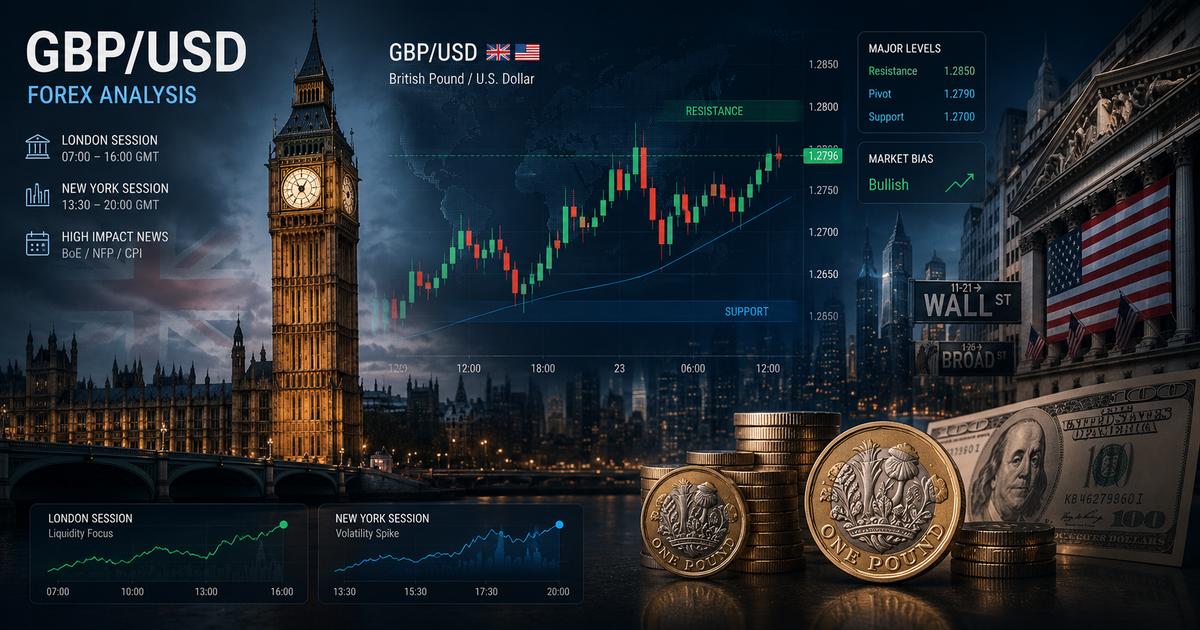
The Origin and Characteristics of "The Cable"
Before diving into the complex macroeconomic forces that swing prices, retail traders must understand the fundamental characteristics of this asset. The term "Cable" is a historical nod to the physical transatlantic telegraph cable laid beneath the ocean in 1858, which served to sync price tickers between London and New York.
Today, GBP/USD is renowned for its deep liquidity, tightly compressed spreads, and distinct volatility profiles. It exhibits significant intraday movement, frequently experiencing sharp, directional breakouts that offer ample profit potential for short-term speculators. However, this high-beta nature requires robust execution. Implementing systematic framework principles, such as utilizing a disciplined psychology to overcome recency bias, is mandatory to prevent getting caught in premature intraday reversals.
Monetary Policy Differentials: Central Bank Divergence
The absolute primary driver of long-term trends in GBP/USD is the structural interest rate differential between the Bank of England (BoE) and the Federal Reserve (Fed). Currency markets operate on relativity; money flows where capital receives the highest risk-adjusted yield.
When the Bank of England adopts a hawkish stance—raising the Bank Rate to combat domestic inflation—it increases the yield profile of Sterling-denominated assets. If the Federal Reserve is simultaneously pausing or cutting interest rates, capital leaves the US Dollar to chase higher British yields, causing GBP/USD to rally.
Conversely, when the Fed aggressively hikes the Federal Funds Rate while the BoE lags behind due to weak domestic growth, the interest rate differential widens in favor of the Greenback, driving the Cable into macro downtrends. Traders must dissect the post-meeting statements, dot plots, and voting splits of the Monetary Policy Committee (MPC) and the Federal Open Market Committee (FOMC) to predict structural directional shifts.
High-Impact Economic Catalysts to Monitor
Intraday and swing traders should build their operational schedules around a strict macro calendar. The Cable reacts violently to data surprises across both geographic regions. The most critical data points include:
- Gross Domestic Product (GDP): Quarterly updates provide a holistic report card of economic growth. Stronger UK growth signals higher capacity for rate increases.
- Consumer Price Index (CPI): The metric that keeps central bankers awake at night. High inflation prints force banks to remain restrictive, usually boosting the currency in the short term.
- Employment Reports: In the United States, the Non-Farm Payrolls (NFP) report released on the first Friday of every month is a massive engine of volatility. On the UK side, average weekly earnings data is watched closely for wage-price spiral signals.
When trading through these macroeconomic updates, standard technical levels can become temporarily invalidated by severe slip and spread spikes. Managing exposure via strict position sizing frameworks is your only true shield against severe balance erosion during news-driven events.
Geopolitical Risk and Post-Brexit Structural Flows
Historically, the British Pound was perceived purely as a stable, major G10 currency. However, the 2016 Brexit referendum permanently altered the underlying mechanics of the asset. The separation from the European Union introduced structural frictions into the UK economy, making the currency more sensitive to political risk.
Periods of political instability in Westminster or ongoing trade disputes regarding international supply chains can depress structural investments in the UK. During these regimes, the Sterling can behave more like a risk-sensitive currency than a traditional safe haven. Traders must evaluate global risk appetites; when global stock markets collapse, institutional players scramble back to the liquidity of the US Dollar, dragging the Cable down regardless of local UK factors.
Intermarket Ties: Global Risk and Cross-Asset Dynamics
The US Dollar operates as the undisputed global reserve currency. Consequently, GBP/USD shares a deep relationship with broader asset classes. When trading the Cable, savvy market participants do not view it in isolation; they constantly cross-reference market conditions with structural commodities.
For instance, during macro environments characterized by extreme global inflation or geopolitical flight-to-safety, checking trends via a comprehensive gold trading guide provides deep insights into whether the US Dollar is experiencing systemic inflows. A massive, broad-based rally in gold often indicates an impending peak in real yields, which can precede a structural turnaround for the Cable against an overextended dollar.
Technical Playbook for the Cable Trader
While fundamentals dictate the macro trend, technical analysis maps your exact execution zones. Because GBP/USD experiences massive speculative flows, it honors psychological key levels and institutional liquidity pools.
- The London Open Breakout Strategy: London is the epicentre of FX volume. Between 07:00 and 09:00 GMT, massive orders enter the book. Traders look for a clear breakout above or below the Asian session range to capture the initial momentum.
- The 1.3000 / 1.3500 Psychological Big Figures: These institutional round numbers act as massive support and resistance clusters. Options market makers heavily defend these barriers, creating highly reliable mean-reversion zones.
- Transatlantic Session Overlap Volatility: The four-hour window from 12:00 PM to 4:00 PM GMT—when London and New York are open simultaneously—accounts for the vast majority of daily turnover, creating pristine conditions for trend-following systems.
GBP/USD Trading FAQ
Why is the GBP/USD currency pair called 'The Cable'?
The nickname dates back to the 19th century when a transatlantic telegraph cable was laid under the Atlantic Ocean to synchronize exchange rates between the London Stock Exchange and the New York Stock Exchange.
How do BoE and Fed interest rate decisions affect GBP/USD?
When the Bank of England (BoE) raises interest rates relative to the Federal Reserve, the British Pound becomes more attractive to investors, typically pushing GBP/USD up. Conversely, if the Fed hikes faster than the BoE, GBP/USD usually declines.
What are the most volatile hours for trading GBP/USD?
The peak volatility and liquidity occur during the London-New York session overlap, roughly between 12:00 PM and 4:00 PM GMT (7:00 PM to 11:00 PM BKK), when economic data from both regions hits the market.