One of the most dangerous, yet incredibly common, mistakes made by retail day traders moving from currencies into commodities is assuming that "one lot is always one lot." Opening a 1.00 standard lot trade on GBPUSD feels familiar, stable, and highly predictable. However, executing that very same 1.00 lot volume on Spot Gold (XAUUSD) or WTI Crude Oil without adjusting for contract size and underlying mathematical mechanics can completely destroy a trading account within a few market ticks.
To achieve consistent capital preservation across financial markets, a professional speculator must completely discard generic trading logic. You must look past the superficial lines on your trading platform dashboard and master the deep infrastructure underneath: specifically, contract sizes, pip and tick values, and the varying structural volatility that defines distinct global asset classes.
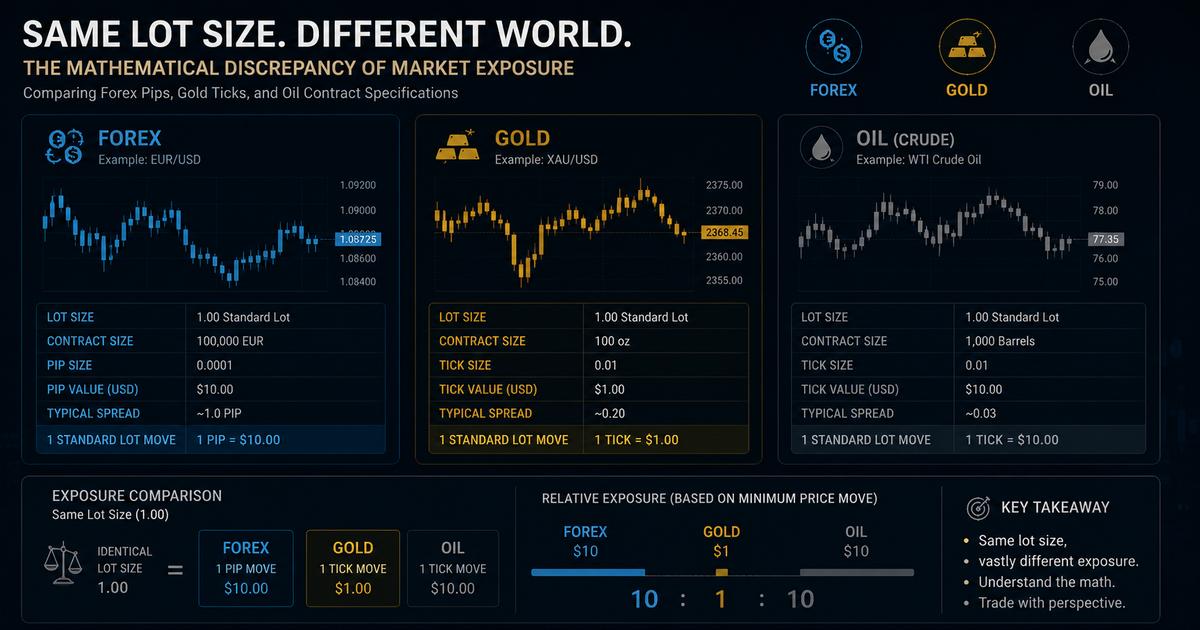
The Illusion of the Uniform Lot Size
In modern multi-asset brokerage terminals, the term "Lot" serves as a standardized wrapper used to simplify transaction execution. However, what sits inside that wrapper depends entirely on the financial asset you are trading. A standard lot is merely a multiplier, and unless you map that multiplier directly to the asset's contract size, you are trading completely blind.
When you execute a position in the currency market, such as our institutional favorite pair analyzed in our GBP/USD market drivers guide, a standard lot represents exactly 100,000 units of the base currency. Shift your focus over to precious metals or energy markets, and the standardized definition breaks down completely. To understand why your trading account swings violently when shifting instruments, we must audit the contract mechanics of these asset groups side-by-side.
Forex Contract Architecture: Decoding the Cable (GBP/USD)
The currency market operates on decimal standardized points. For major currency pairs like GBP/USD, a standard contract size consists of 100,000 units of the base currency (Pounds Sterling). The standard unit of pricing measurement is the Pip (Percentage in Point), which tracks the movement of the fourth decimal place ($0.0001).
The mathematical equation to calculate the monetary value of a single pip in a standard lot is:
For GBP/USD, where the quote currency is the US Dollar, a 1.00 standard lot yields an exact, stable pip value of **$10.00 USD** per pip movement. If the market shifts by 50 pips against your position, your absolute floating equity fluctuates by precisely $500. This fixed value forms the absolute baseline of retail position sizing calculations. And you can find the exact pip value for your trading asset using our pip value calculator.
Gold Contract Architecture: The Leverage Premium of XAU/USD
When we step into the commodity space to look at Spot Gold (XAUUSD), the entire structural landscape changes. Gold isn't measured in paper units; it is measured in physical troy ounces. On almost all global brokerage platforms, a standard lot of Gold represents exactly **100 troy ounces**.
Because Gold is priced directly in US Dollars per single ounce, the minimal practical increment day traders track isn't a traditional pip, but a $0.10 or $0.01 price tick. A full $1.00 movement in the price of Gold (for instance, an increase from $2,350.00 to $2,351.00) means that every single ounce within your contract has increased by one dollar.
Therefore, executing a 1.00 standard lot of Gold means you control 100 ounces. If Gold moves by just $1.00, your monetary exposure is:
Now, think about this relative to your currency pairs: a $1.00 move in Gold is structurally equivalent to a 10-pip move in Forex in terms of financial impact, but Gold regularly moves $20.00 to $40.00 in a single standard session! This extreme sensitivity is why we heavily emphasize specialized risk mitigation protocols within our comprehensive XAUUSD tactical strategy guide.
Crude Oil Contract Architecture: The Energy Multiplier (WTI & Brent)
Crude Oil (West Texas Intermediate or Brent) introduces another unique layer of contract specifications. Oil is transacted based on physical volume measured in barrels. One standard lot of Crude Oil on an exchange typically represents **1,000 barrels** of oil.
Oil prices fluctuate in dollars and cents per barrel. The minimum price movement, known as a tick, is typically $0.01. If the price of WTI Crude shifts from $75.00 to $75.01, that single cent increase applies to all 1,000 barrels inside your standard contract.
Consequently, a full $1.00 move in the price of Oil (e.g., $75.00 to $76.00) results in a massive **$1,000.00 USD** shift in your account balance per standard lot. Because Oil reacts violently to geopolitical events and weekly supply reports, navigating these contract dimensions requires strict technical frameworks, as outlined in our WTI & Brent oil mastery handbook.
The Structural Comparison: Identical Lots, Different Realities
To fully visualize why trading a fixed lot size across these distinct asset spaces is account suicide, let us observe how an identical 1.00 standard lot reacts under normal daily market parameters:
| Asset Class | Standard Contract Size | Standard Price Unit | Monetary Value per Unit (1 Lot) | Average Daily Range (ADR) | Typical Daily PnL Volatility |
|---|---|---|---|---|---|
| GBP/USD | 100,000 Pounds | 1 Pip (0.0001) | $10.00 USD | 80 – 120 Pips | $800 – $1,200 |
| Gold (XAUUSD) | 100 Troy Ounces | $1.00 Net Price | $100.00 USD | $20 – $45 Price Move | $2,000 – $4,500 |
| Crude Oil (WTI) | 1,000 Barrels | $1.00 Net Price | $1,000.00 USD | $1.50 – $3.50 Price Move | $1,500 – $3,500 |
Look closely at the data: executing 1 lot on Gold can instantly expose your capital to **nearly four times** the daily monetary fluctuation of a standard Forex position. If your risk profile is carefully calibrated for currency movements, trading commodities with the exact same volume allocation will result in emotional trading decisions, premature stop outs, or catastrophic margin failure.
Cross-Asset Risk Mitigation: The Professional Solution
How do professional fund managers smoothly allocate risk across currencies, metals, and energy fields simultaneously? They employ two foundational rules:
- Never Risk Fixed Lot Sizes: Your transaction volume must always be a dynamic variable derived from the distance of your technical stop loss and your absolute maximum dollar risk profile per trade.
- Normalize Asset Volatility: Use the Average True Range (ATR) indicator over a 14-day lookback period to scale down your absolute contract exposure whenever an asset enters an inflationary or highly volatile trading environment.
Before committing active capital to multi-asset configurations, ensure you have embedded strict defensive frameworks by checking our core 5 essential risk management strategies to maintain mathematical safety.
Conclusion: Master the Math Before Entering the Market
Market diversity provides incredible trading setups, but it requires thorough mathematical accountability. Never let a brokerage platform's standardized buttons trick you into treating GBPUSD, Gold, and Oil as identical twins. They operate on entirely different mechanical levels. Calculate your contract dimensions, align your risk profiles meticulously, and protect your capital at all costs.
Multi-Asset Contract Specifications FAQ
Why does 1 lot of Gold fluctuate much more in dollar value than 1 lot of GBPUSD?
This discrepancy exists because of differing contract sizes and asset inherent volatility. A standard lot of Forex represents 100,000 units of the base currency where a pip move equals $10. In contrast, 1 lot of Gold represents 100 troy ounces, meaning a single $1 price movement causes a $100 shift in equity, multiplied by Gold's significantly larger average daily pricing range.
What is the difference between a pip in Forex and a tick in Commodities like Oil?
A pip is the standard unit of measurement for currency price changes, typically representing the fourth decimal place (0.0001). A tick is the minimum price fluctuation allowed by exchanges for commodities like Crude Oil, where a 0.01 change per barrel in a standard 1,000-barrel contract equates to a baseline fluctuation of $10.
How should a multi-asset trader adjust risk when switching between Forex pairs and Oil?
Traders must abandon rigid lot sizes and instead adopt dynamic, volatility-adjusted position sizing. By determining the exact technical stop loss distance and using specific asset calculators, you keep your absolute monetary risk identical (e.g., 1% of account balance) regardless of whether you trade currencies or energy markets.