The paradigm shift in modern retail speculation has unlocked access to institutional scale liquidity pools. Proprietary trading firms (Prop Firms) allow disciplined retail operators to control evaluation setups spanning significant amounts in capital. However, the operational gateway is highly protected. Recent industry data reveals an alarming reality: over 90% of aspiring market participants fail to pass initial verification trials. This high failure rate is rarely caused by poor directional trade selection; rather, it is triggered by an algorithmic failure to audit internal parameters before purchasing the evaluation challenge.
1. Demystifying Server-Side Risk Infrastructure
Before committing capital to an introductory evaluation model, a retail speculative operator must grasp that proprietary servers execute risk evaluation loops dynamically every few milliseconds. They do not operate on subjective human intervention; they enforce computerized code designed to insulate the corporate liquidity ecosystem from sudden tail-risk events.
Traders routinely enter tests assuming that their traditional retail stop-losses will seamlessly align with corporate boundaries. In practice, failure to align local execution frameworks with automated clearinghouses results in near-instant account liquidation sequences, even on setups that eventually recover to net profit targets.
2. Mathematical Alignment: Balance vs. Equity Tracking Architecture
The most foundational element of your strategic preparation model involves identifying the specific mathematical algorithm driving the firm's automated risk monitoring system. Prop firm platforms enforce two entirely distinct tracking methodologies:
- Balance-Based Model: The tracking engine captures the fixed cash allocation snapshot at precisely midnight server time (00:00 server time). This value forms a static risk baseline for the next twenty-four hours.
- Equity-Based Model: Utilized aggressively by various global funding programs, this framework dynamically establishes your new daily threshold based on whichever metric is higher at midnight: closed balance or floating equity.
If you carry profitable floating positions across the daily market rollover window, an equity-based system anchors that inflated peak valuation as the new tracking ceiling. To survive this highly sensitive configuration, operators must implement deep mathematical controls. For a granular architectural analysis of these specific tracking mathematics, review our master pillar thesis on The Science of Daily Drawdown: How to Never Breach Prop Firm Rules.
| Checklist Category | Target Preparation Target | Operational Focus Area |
|---|---|---|
| 1. Risk Engine Mapping | Confirm Equity vs. Balance Rules | Mitigate overnight baseline expansion traps. |
| 2. Volatility Normalization | ATR-Driven Position Sizing | Calibrate contract sizes based on asset beta metrics. |
| 3. Execution Scripting | Deploy Algorithmic Protection Tools | Eradicate human operational calculation latency. |
| 4. Macro Slicing | News Restrictive Avoidance | Audit permitted news windows to bypass hard liquidations. |
3. Asset Volatility and ATR-Driven Contract Sizing
A universal mistake among emerging speculation operators is executing static lot allocations across varying financial instruments. Applying identical volume weights to highly consistent forex pairs like GBPUSD versus extreme-beta commodities like Gold (XAUUSD) or Crude Oil (USOIL) introduces fatal tracking vulnerability. High-beta configurations undergo violent structural swings that can drain an entire daily drawdown allocation inside an isolated 15-minute execution path.
To systematically neutralize asset variance, traders must establish contract volumes based entirely on a 14-period Average True Range (ATR) calculation. If underlying historical distribution curves widen on a particular trading asset, lot configurations must scale down in perfect inverse proportion to keep maximum mathematical stop exposure tied closely to standard capital thresholds.
4. Algorithmic Automation vs. Manual Latency Errors
Relying entirely on manual entry workflows, physical speed, or mental computations under intense market stress introduces structural risks. The processing time required for a human brain to calculate dynamic compounding values while managing high-frequency pricing inputs creates critical processing latency.
Capitalized market professionals bypass this risk completely by implementing automated position sizing tools prior to initializing orders. Running all entry setups through an institutional-grade validation algorithm guarantees that your protective stop placements remain mechanically locked underneath server restrictions, entirely eliminating human calculation error.
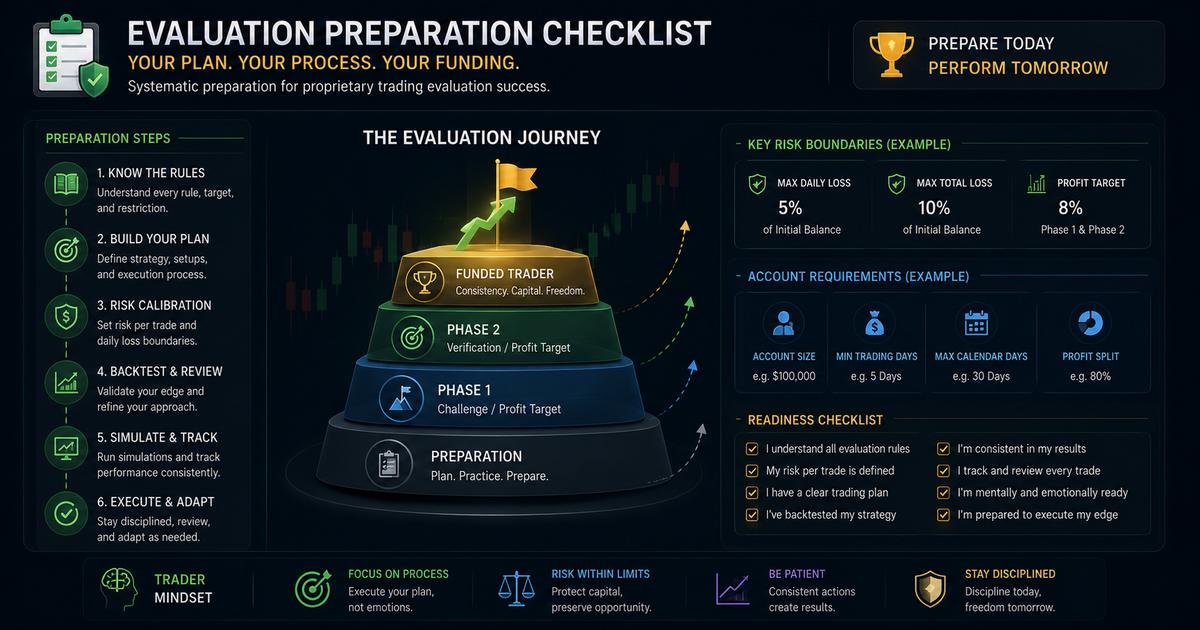
5. Operational Checklist: Five Critical Rules for Challenge Preparation
To ensure your next evaluation process maintains maximum stability and survives to yield regular payouts, integrate these five foundational rules into your preparation sequence before finalizing your application:
- Audit the Specific Platform Architecture: Explicitly log whether your chosen challenge provider utilizes balance or equity parameters. If equity-based rules govern your evaluation, you must establish an ironclad midnight flattening routine.
- Calibrate Lot Allocations Systematically: Never execute an order without calculating exact parameters via an external processing script. Utilize our specialized Prop Firm Daily Drawdown Limit Calculator to lock entry parameters flawlessly underneath permitted boundary constraints.
- Verify News Restriction Windows: Multiple institutional evaluation accounts are permanently revoked due to executing orders during volatile macroeconomic release windows. Map out global high-impact schedules prior to session initialization.
- Quantify Maximum Daily Headroom: Assess real-time asset ATR layers across Daily and Hourly timeframes. Restrict combined session risk to a maximum of 1.5% to 2% of your available daily drawdown allowance to guarantee structural safety buffers.
- Simulate Drawdown Recovery Metrics: If a set of trades triggers an initial capital uncertainty sequence, execute a structured recovery model immediately. For an in-depth blueprint on re-establishing mechanical rules following capital retracements, read our expert operational framework on recovering from trading drawdowns.
Eliminating Human Margin of Error via Systematic Calculators
Transitioning from volatile retail trading habits into a systematic, funded lifestyle requires implementing flawless risk tools. Do not leave fractional position tracking to guesswork or loose estimates. Prior to risking capital on a live evaluation layer, process your data through professional analytic components to protect your portfolio.
Conclusion: Flawless Operational Execution Secures Consistent Payouts
Navigating modern proprietary trading platform evaluation phases has very little to do with locating legendary chart forecasting secrets. It relies entirely on executing tight operational risk boundaries with mathematical discipline. By structuring asset metrics carefully, flattening open exposures before daily server resets, and anchoring every setup beneath algorithmic constraints, you position your strategy to thrive. Safeguard your risk floor, and your capitalization curve will expand automatically.
Prop Firm Challenge Preparation FAQ
Why do over 90% of beginners breach modern prop firm daily drawdown parameters so quickly?
Most introductory operators focus strictly on price chart patterns while completely ignoring the underlying risk engine architecture. Modern proprietary platforms implement highly sensitive equity or balance-based daily drawdown tracking mechanisms. Carrying floating setups past daily rollover points can shift risk baselines, leaving accounts vulnerable to automated liquidations on standard intraday market retracements.
How does an algorithmic lot size tool prevent rule violations during global market news?
A specialized position sizing calculator dynamically analyzes historical asset variance and live ATR measurements. By scaling account lot structures proportionally to specific risk inputs, the script ensures that any immediate volatility expansion or unexpected market slippage remains completely locked beneath the absolute maximum daily loss boundary permitted by the firm.
Should a beginner flatten all open trading setups before the daily server rollover clock?
Yes, absolutely. Under institutional equity-based risk assessment rules, transforming open floating exposure into realized cash balances exactly fifteen minutes prior to midnight prevents the evaluation server from logging artificial trailing benchmarks, protecting precious capitalization headroom from tightening constraints.